Breaking news

Artefacts
You’ll find here captivating stories about dishonest archaeologists who attempted to sell valuable artifacts for personal gain. You can also explore a rich collection of extraordinary artifacts discovered across Europe including Brooch-Pins, copper axe heads, pieces of Trojan Armor, Medieval Hauberks. Roman, Viking and Anglo-Saxon coins. Saxon crosses as well as Victorian gold rings, Medieval bishops’ rings, Tudor Love Rings and many more. It’s a fascinating journey through history, filled with treasures and the mysteries of ancient civilizations.
Theft of Historic Vases by Archaeologist

James Vessey, a former archaeologist, stole three 17th-century Bellarmine vases during a 2008 excavation in Bath and attempted to sell them on eBay. He was caught after a fellow archaeologist spotted the items online, leading to a police raid on his Oxfordshire narrowboat home. Vessey, who had a prior conviction for similar thefts, received a four-month suspended sentence and 270 hours of community service.
The vases, traditionally used to ward off witchcraft and originating from Cologne, Germany, were returned to the Roman Baths Museum after examination. Museum manager Stephen Clews emphasized their importance in understanding medieval Bath’s history. (read more)
Historic Theft Shakes British Museum

Dr Peter Higgs, a senior curator at the British Museum, was dismissed after over 1,800 artefacts were found missing, stolen, or damaged. Many of the items, including ancient gems and jewellery, were allegedly sold on eBay using false identities and PayPal.
The High Court ordered Higgs to return any stolen items within four weeks, though he denies the accusations and has not been criminally charged. Investigations revealed that some artefacts were recovered in the U.S. and Germany, with help from the FBI and collectors who unknowingly purchased them. The scandal has shaken the museum world and led to major reforms in collection security and oversight. (read more)
Artefacts Vanish in Museum Care

Metal detectorists Chris Linton and Peter Major reported their treasure finds to the Lancashire County Council Museum Service in Preston after discovering them in Penrith and near Aldingham, respectively. Linton had uncovered more than sixty 13th‑century silver coins during a dig in Penrith, while Major found a hoard of silver coins and three axe heads near Aldingham. Both men followed the law and submitted their finds for assessment through the Portable Antiquities Scheme, expecting updates on valuation and museum interest. After two years without news, they learned that several artefacts had gone missing from the museum’s storage. A later review revealed that as many as twelve registered treasure cases and their files had disappeared.
Lancashire Police launched an investigation in 2022, arresting one individual and recovering some items. In 2025, however, the Crown Prosecution Service concluded that the evidence did not meet the threshold for charges. Linton expressed frustration, saying detectorists care deeply about preserving history, not just potential rewards. Major said the experience damaged his trust in the system and discouraged him from continuing the hobby. Lancashire County Council stated it is strengthening procedures and working to return all recovered items to the affected finders. (read more)
Detectorist Confesses to Hidden Roman Find

A metal detectorist in Lower Saxony has admitted to illegally excavating a major Roman hoard in 2017 after hiding it for eight years. The treasure includes about 450 silver denarii, silver bars, a gold ring and a gold coin, making it one of the largest Roman Imperial hoards ever found in the region.
It was discovered near Borsum by Jannik Pauli, who had been detecting without the required permit and chose to keep the find secret to avoid legal trouble. He stored the hoard in a wooden box at his home until finally confessing to police this year. Although prosecutors could no longer charge him due to the statute of limitations, archaeologists were able to investigate the site he revealed. (read more)
Heritage Sites Plundered by Illegal Treasure Hunters

A hoard of nearly 900 illegally excavated artefacts has revealed the scale of heritage plundering in Ireland, according to the National Museum. The items were recovered after a tip‑off from the British Museum about medieval Irish coins that had been exported illegally. A British man living in Co Tipperary had spent years secretly detecting historical sites, even using night‑vision equipment.
The haul included medieval silver coins, Bronze Age objects, “gun money,” and hundreds of 17th–19th‑century buttons. Authorities warn that such looting carries penalties of up to four years in prison and a €63,500 fine. (read more)
Viking Treasure Looters Sentenced

A Viking age hoard was discovered in 2015 near Eye, close to Leominster in Herefordshire, England, containing more than 300 coins, a gold ring and other rare treasures. Instead of reporting the find as required by law, metal detectorists George Powell and Layton Davies secretly removed the hoard and sold much of it for profit.
Powell was sentenced to 10 years in prison, later reduced to 6, while Davies received 8 years and 6 months, later reduced to 5. In 2024, Davies was given an additional 5 years and 3 months for failing to repay the proceeds of the crime. The hoard is considered one of the most significant Viking discoveries in Britain, and efforts to recover the missing artefacts are still ongoing. (read more)
Detectorist Exposed for Faking ‘Roman’ Brooch Find

A Lincolnshire detectorist, Jason Price, falsely claimed he had discovered an 1,800‑year‑old Roman horse brooch that he had actually bought on eBay. The item was celebrated as a major find, displayed in a museum, and even featured on television before tests revealed it was no older than the 16th Century.
Suspicion grew after Price submitted more supposedly Roman objects, leading experts to realise several items had likely been planted. Price admitted four counts of fraud, repaid the £5,000 he received, and received a 12‑month suspended sentence along with unpaid work and rehabilitation days. Archaeologists described the deception as a serious betrayal that wasted resources and undermined trust in genuine discoveries. (read more)
Major Archaeological Finds in Buttevant - Co. Cork

Nearly 3,000 artefacts were uncovered during street excavations in Buttevant, County Cork, causing delays to the reconstruction works. Archaeologists discovered parts of a northern gate tower, sections of the old town wall, building foundations and layers of medieval cobbled streets. The finds also included animal bones, pottery, tiles, bone combs, coins, buttons, buckles, pins, clay wig curlers and a gold posy ring dated 1713.
The excavations confirmed Buttevant’s origins as a medieval walled town founded around 1208, with its formal layout completed by the mid‑13th century. The town later suffered major destruction in 1569 and 1691 before being revived in the 18th century. (read more)
The Lough Kinale Book Shrine - Co. Longford

Discovered in 1986 beneath the waters near a crannóg (lake-dwelling) in Lough Kinale, Co. Longford, this ornate 9th-century shrine is the earliest and largest of Ireland’s surviving book shrines.
Designed to enshrine a sacred manuscript, it features tinned bronze plates, a cast copper-alloy cross with amber studs marking Christ’s wounds, and richly decorated zoomorphic and geometric motifs. (read more)
Gosfield Medieval Seal Matrix Discovery - England

A metal detectorist in Gosfield, Essex uncovered a rare medieval seal matrix set with a much older Roman intaglio gemstone in September 2023. The silver seal, inscribed “+SECRETVM RICARDI”, was made for a man named Richard between 1200 and 1400. Its centrepiece a finely carved carnelian showing a charioteer and two horses dates back to the late 1st Century BC or early 1st Century AD.
Such reused Roman gems were symbols of learning, wealth, and status in the medieval period. The find has been declared treasure, giving museums the chance to acquire it. (read more)
The Seal of Roberd - England

One of Moyse’s Hall Museum’s most significant acquisitions of 2023 is a silver medieval seal matrix, discovered in Suffolk and declared treasure through the Portable Antiquities Scheme. Measuring approximately 22 mm in height and weighing 22.29 grams. It is a finely crafted and unusually substantial example.
The seal features a swan surrounded by fleur-de-lis and bears the inscription IE SVY LE CIN ROBERD, now interpreted as a clever pun meaning “I am the swan/sign of Roberd.” Experts believe it may have belonged to Robert Swann of Saxmundham, a 14th-century figure. Its rarity, symbolism, and linguistic play make it a valuable glimpse into medieval identity, and research into its origins continues. (read more)
The Ardshanbally Brooch Pin - Co. Limerick

In July 2024, archaeologist Jimmy Dobson uncovered a beautifully preserved 9th-century bronze brooch-pin at Ardshanbally, part of the Foynes to Limerick Road Project. The site lies near Adare, Co. Limerick, in a rich early medieval landscape with ringforts and historic towns.
The Brooch-Pin made of cast bronze (copper, tin, lead), with blue glass studs and amber insets. Features zoomorphic designs and ribbon interlace patterns. Associated textile fibres hint at clothing it once adorned.
Conservators cleaned and stabilized the brooch using alcohol swabs, microscopes, and treatments to halt corrosion. It was then sealed and prepped for exhibition. (read more)
A copper axe head - Co. Dublin

On 30 March 2025, which fell on Mother's Day, a copper axe head from the Early Bronze Age was discovered. The artifact was found on a hill between Bohernabreena Cemetery and the ruins of Carthy's Castle.
The axe head is believed to date back over 4,000 years, offering a rare glimpse into prehistoric craftsmanship in the Dublin Mountains. Archaeologists noted its excellent preservation, suggesting it may have been a ceremonial object rather than a utilitarian tool. (3D View) Raport (PDF) Table (PDF) (Museum) (Map)
Trojan Armor Found - Czech Republic

An amateur metal detectorist in the Czech Republic discovered a collection of bronze artifacts in 2023, including a folded piece of metal later identified as ancient armor. After two years of analysis, experts confirmed it was a 3,200-year-old chest plate likely worn by an elite warrior during the Trojan War. Only privileged fighters had access to bronze armor, making this an extremely rare find.
The ornamentation revealed through 3D scanning and microscopy helped confirm its purpose and craftsmanship. This is just the second known piece of bronze armor ever found in the Czech Republic. (read more)
The Crosby Garrett Roman Helmet - England

A spectacular Roman cavalry parade helmet was unearthed in fragments on farmland near Crosby Garrett in Cumbria in May 2010, revealing an intricately modelled bronze face mask and a crested cap. The helmet, dating to the late 2nd or early 3rd century AD, was one of the most remarkable Roman finds ever made in Britain.
After its discovery, it was rapidly restored and controversially sold at auction, raising concerns about the loss of archaeological context and gaps in the Treasure Act. Subsequent investigations showed the helmet had been deliberately folded and buried near a Romano‑British settlement. (read more)
Medieval Hauberk Discovered - Co. Longford

A hauberk dating back to around 1172 was discovered in County Longford. It had been stored in a shed until its finder saw a replica at a Norman heritage event. The artefact was handed over to Granard Knights & Conquests and will go to the National Museum of Ireland.
Experts believe it may be linked to Richard De Tuite and the motte castle built in 1199. Its intact condition makes it a rare and exciting find during Heritage Week. (read more)
Bronze Age Peebles Hoard - Scotland

The Bronze Age Peebles Hoard, discovered in Scotland in 2020, has revealed an exceptionally rare silvery surface during conservation, unlike the usual golden or brown patinas of ancient bronze. Thanks to the detectorist’s responsible reporting, archaeologists were able to lift the entire hoard in a soil block, preserving fragile elements like leather harness straps and a complete wooden scabbard. After four years of analysis, more than 500 objects dating to 1000–800 B.C. were identified, including some of Scotland’s earliest lost‑wax cast bronzes.
Conservation work began in 2024 and is expected to take three years due to the delicate removal of corrosion and soil. As surfaces were exposed, several pieces showed a tin‑rich silver sheen, suggesting a rare Bronze Age technique that deliberately enriched the metal’s surface. (read more)
Roman Panther Unearthed - England

A rare Roman carriage fitting found in Essex in 2024 features a panther standing over a severed head, dating from AD 43–200. Experts say it would originally have gleamed brightly and likely decorated the vehicle of a well‑off farmer or merchant. Because Roman carriages were mostly made of wood and metal parts were often melted down, such fittings are exceptionally uncommon.
The imagery blends Roman symbols of victory and luxury with Iron Age geometric patterns, making it a unique Romano‑British piece. Archaeologists believe it offers valuable insight into how people in Roman Britain travelled and expressed status. (read more)
Roman Horse Head Discovery - Germany

Archaeologists uncovered a remarkably preserved 2,000‑year‑old Roman bronze horse head during a 2009 excavation on a farm in Lahnau, Germany. The artifact had been submerged in a 36 foot well, protected by water and sealed from air, which helped preserve its gilded surface.
Although the state initially paid the landowner just €48,000, he later sued after learning how significant and valuable the discovery truly was. A regional court eventually ruled that he was entitled to half of the artifact’s estimated €1.6 million value. As a result, the government now owes him €773,000 plus interest for what experts consider one of the best‑preserved Roman bronzes ever found. (read more)
14th Century Bulla of John XXII Found - Poland

A 14th Century papal bulla has been discovered near Kołobrzeg and has now entered the collection of the Koszalin Museum. This rare lead seal bears the name of Pope John XXII, who reigned from 1316 to 1334 as the second pope of the Avignon Papacy. Its obverse shows the figures of Saints Peter and Paul, following the traditional iconography of papal bullae.
Although the document to which it was once attached remains unknown, the find is exceptionally valuable, as no more than about twenty such bullae have survived in all of Poland. John XXII played a significant role in Polish history, approving the coronation of Władysław Łokietek and ordering the Teutonic Knights to return Pomerelia, seized in 1308. (read more)
Roman Coins Found in Senon - France

Archaeologists in northeastern France uncovered three clay amphorae hidden beneath the floor of an ancient home, containing more than 40,000 Roman coins. The hoard, weighing about 183 pounds, had been used as a kind of buried savings system during the late 3rd to early 4th century C.E. The site belonged to the Mediomatrici, a Celtic tribe living in the region long before and during Roman rule. Two of the vessels were packed with tens of thousands of coins, while the third held only a few.
Evidence shows the hoard was buried before the settlement was repeatedly destroyed by fire, indicating it predates full Roman control of the area. (read more)
The Largest Roman Coin Hoard - Spain

In 2016, construction workers in Tomares, Spain uncovered 19 Roman amphorae filled with coins, sparking international attention. Six years later, researchers confirmed the stash held around 53,000 coins, minted between 294 and 311 AD. The treasure was buried beneath a Roman villa’s portico, likely during the 4th century.
Experts analyzed nearly 6,000 coins to understand their origin and purpose. The amphorae, originally used for oil, were stored in a hidden granary that was later dismantled, leaving the treasure untouched for centuries. (read more)
Mystery of Buried Roman Coins - England

A hoard of 1,368 Roman coins, mostly silver denarii, was discovered in Worcestershire, England, buried around A.D. 55 during Emperor Nero’s reign. The coins span minting dates from 157 B.C. to A.D. 55, with one rare gold coin from the local Dobunni tribe. Experts believe the coins likely arrived via the Roman army and represented a significant fortune at the time.
The reason for their burial remains unknown, though one theory suggests they were savings from a wealthy farmer supplying grain and livestock to Roman forces. Nero’s reign was marked by turmoil, including rebellion, murder, and eventual suicide. (read more)
17th Century Treasure Found in Church - Germany

Restorers at St. Andrew’s Church in Eisleben, Germany, uncovered four hidden bags of 17th‑century coins inside a statue’s leg. The hoard, containing 816 gold and silver coins, was likely concealed around 1640 during the chaos of the Thirty Years’ War. Experts say it represents a “huge fortune,” far more than a craftsman could earn in a year.
Labels on the most valuable coins suggest the money came from church income such as weddings, baptisms, funerals, and paid seating. The treasure survived centuries of war, plundering, and population loss before finally being revealed. (read more)
Lost Viking Fortune Found - Isle of Man
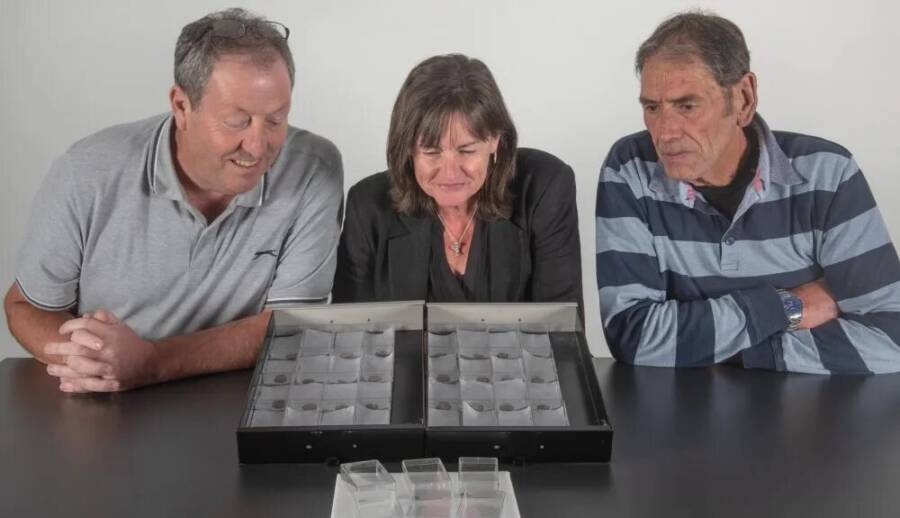
A remarkable Viking‑Age treasure has emerged from the Isle of Man, where metal detectorists John Crowe and David O’Hare uncovered a hoard of 36 silver coins dating from 1000 to 1065 C.E. The find, examined by Dr. Kristin Bornholdt Collins, reveals coins minted under Edward the Confessor, Canute, and Sihtric Silkbeard, showcasing the island’s deep entanglement in North Sea trade. The mix of English and Irish issues reflects a highly mobile economy in which wealth circulated freely across the Irish Sea.
Experts believe the hoard was assembled in stages, with earlier coins buried first and later additions from Edward’s reign completing the cache. Its discovery highlights the Isle of Man’s status as one of the richest Viking silver landscapes in Europe. Why the treasure was abandoned around 1070 C.E. remains a mystery, though turmoil or simple misfortune may have played a role. For archaeologists, the hoard offers an exceptional chance to study Viking coinage side by side, right down to the individual dies used to strike them. (read more) (Pic)
The Mørstad Viking Hoard - Norway

The Mørstad hoard, already Norway’s largest Viking‑age coin hoard, has now surpassed 4,344 silver coins, with more being uncovered every day. The discovery began on 10 April 2026, when two metal detectorists, Rune Sætre and Vegard Sørlie, found the first coins scattered in the plough layer of a cultivated field on the Mørstad farm near the town of Rena in Østerdalen.
Archaeologists later took over the site and, after removing the unusually thick topsoil, continued recovering 70–100 coins per day. The hoard includes a Danish penny of Harthacnut and four extremely rare early coins of Harald Hardråde, minted around 1046–47. Despite the unprecedented size of the treasure, no traces of settlement, graves, or structures have been found in the area, making the discovery even more enigmatic. (read more)
15th Century coin hoard - Scotland

Two metal detectorists have unearthed a hoard of 15th Century coins in the Scottish Borders. Keith Young and Lisa Stephenson discovered 30 gold and silver coins in close proximity in the Cappercleuch area which is near St Mary's Loch.
The coins are a mix of Scottish and English coins, comprising English silver groats minted by Henry V (1413-1422) to Edward IV (1461-1483), and Scottish gold demy and half-demys of James I (1406-1437) and James II (1437-1460). (read more)
Viking Coin Hoard Found on Isle of Man - United Kingdom

A hoard of 36 Viking Age silver coins, minted between 1000 and 1065 C.E., was discovered on the Isle of Man by two metal detectorists. The coins, declared official treasure, were minted in cities across England and Ireland, including York, London, and Dublin. Most date to the reign of Edward the Confessor, with others from the time of Viking ruler Canute and Irish king Sihtric Silkbeard.
Experts believe the hoard was assembled in stages and likely abandoned before 1070 C.E. The find sheds light on the Isle of Man’s central role in Viking trade and settlement. (read more)
Coin Hoard Discovered in Bunnik - Netherlands

A rare hoard of 44 British gold coins bearing the name of Celtic king Cunobelinus was discovered in a Dutch field alongside 360 Roman coins. Archaeologists believe the coins were spoils of war from the Roman conquest of Britain around AD43.
The hoard, buried in a shallow pit, likely belonged to a Roman soldier and represents about 11 years of military wages. Some coins were posthumous issues from Cunobelinus’s successors, Togodumnus and Caratacus. The find includes Roman coins dating from 200 BC to AD47, now displayed at the Dutch National Museum of Antiquities. (read more)
Rare 7th Century Anglo-Saxon Coin - England

A tiny gold coin dating from AD 640–660 was discovered in a field near Norwich and is believed to be the oldest Anglo-Saxon coin found in East Anglia. The coin features a male figure holding a Christian cross above a valknut, a pagan symbol linked to the Norse god Odin.
Experts say the design reflects a transitional period between paganism and Christianity. Coin specialist Adrian Marsden called it a “massively significant” find and noted it’s the first of its kind ever seen. Norwich Castle Museum hopes to acquire the coin for its collection. (read more)
Historic Find in Garden - Scotland

Craig Smith, a man from Linlithgow, Scotland, discovered a 700-year-old gold coin while repairing a fence in his garden. Experts identified it as a William I of Guelders gulden, dating back to 1379.
The coin is one of only three ever found in Scotland and may be worth around £1,500. William I was a notable European nobleman known for his military campaigns and alliances. The artifact has been handed over to Treasure Trove Scotland for preservation. (read more)
Discovery in Portarlington - Co. Laois

In 1947, more than 100 gold coins and several silver coins were discovered by three woodcutters Joe Clarke, Joe Maher and Mike Daly after they spotted a rabbit carrying a coin in its mouth and dropping it outside its burrow. The rabbit had apparently been clearing out its warren, unintentionally revealing long‑hidden treasure. When the men began digging, they uncovered dozens of coins lying together beside fragments of the wooden box that once contained them. The hoard had been buried in the 17th century in an area where, under Cromwell’s harsh rule, Catholics were forbidden to live. Experts from the National Museum believe the treasure may have been hidden by an Irish Army treasurer during Cromwell’s invasion.
The hoard included six rare coins known as ‘pistoles’, struck in Dublin in 1646 by the Duke of Ormonde as emergency war‑money. These pistoles undated and stamped “4 dwt 7 gr” on both sides formed part of the Duke of Ormonde’s gold coinage of 1646–47. In response to a severe shortage of coinage, he authorised Gilbert Tonques and Peter Vaneindhoven, two founder members of the Dublin Goldsmiths Company, to mint gold coins weighing 4 dwt 7 gr and 8 dwt 14 gr. These became known as pistoles and double pistoles, named by analogy with similar European gold coins. They remain the only gold coins ever struck in Ireland. "4 dwt 7 gr" equals about 6.67 grams. In the troy weight system, 1 Pennyweight (dwt) weighs 1.55517384 grams, and 1 Grain (gr) is 0.064799 grams. (read more)
The Carrick‑on‑Suir Gold Hoard - Co. Tipperary

Discovered on 14 January 2013 by construction workers, the hoard consists of 81 gold coins dating from 1664 to 1701. Most are guineas, with a few half‑guineas, spanning the reigns of Charles II, James II, William and Mary, and William III. The coins were found beneath floorboards of a Main Street house, likely once wrapped together before the material decayed.
After the discovery, they were handed to local Gardaí and reported to the National Museum of Ireland. Archaeologists from the Museum and the National Monuments Service later investigated the site, acknowledging the finders for their prompt reporting. (read more)
€2M Coin Hoard Found in Wall - France

A hidden stash of around 1,000 historic gold coins worth €2 million was discovered in the wall of a house in Castillonnès, southwestern France. The coins, spanning from ancient Greece to the 19th century, were collected over a lifetime by Paul Narce, a reclusive local resident. After Narce’s death in August 2024, the trove was found behind a picture in a storage room by a notary managing his estate.
Among the collection were ten pouches of “Napoléons” and a rare Louis XVI coin valued at up to €3,500. Experts praised the quality and scope of the collection, now being sold in Paris. (read more)
Rare Henry III Coin Found in Devon - England

Michael Leigh-Mallory discovered a rare Henry III gold coin from 1257 in a Devon field during his first metal detecting outing in over a decade. The coin, found just 4 inches deep, is the first of its kind unearthed in 260 years and one of only eight known to exist. It features Henry III on the throne and a cross with roses on the reverse.
The coin fetched £540,000 at auction, with the buyer planning to display it in a UK museum. Leigh-Mallory said the historical significance of the find far outweighed its monetary value. (read more)
Roman Gold Coin Hoard - Luxembourg

Archaeologists in Luxembourg uncovered 141 Roman gold coins dating back 1,600 years at a site in Holzthum. The coins feature nine emperors from the fourth and fifth centuries, including the rare depiction of Eugenius, a short-lived usurper.
Excavations began after amateur detectorists found coins in 2019, with professionals continuing the dig through 2024. Due to leftover World War II munitions, the Army Mine Action Service assisted in the excavation. The coins, mostly solidi, are valued at €308,600 and were found near remains of a Roman fortress. (read more)
First Viking Silver Coin - England

A rare silver penny minted by Viking ruler Guthrum was discovered by detectorist Malcolm Weale in eastern England. The coin, dating to the ninth century, is the first known silver currency issued by a Viking in Britain. It was unveiled at the British Museum’s annual treasure launch, showcasing finds from 2023 and 2024.
Weale described the discovery as “life-changing” after decades of metal detecting. The coin was displayed alongside other remarkable artifacts, including ancient tools and jewelry. (read more)
Roman Coin Hoard Found in Leicestershire Field - England

David Dunn, a metal detectorist from Leicestershire, discovered a hoard of 50 Roman coins in a local pasture. The coins, dating to the late 3rd century, include Antoninianus pieces from emperors like Carausius, Allectus, Diocletian, and Maximian.
Dunn, who has been detecting for just two years, described the find as “once-in-a-lifetime.” The hoard will be auctioned in February 2025 for an estimated £1,200–£1,500. Dunn plans to give most of the proceeds to the farmer who helped uncover the coins. (read more)
Galloway Hoard on Display - Scotland

The Galloway Hoard, the richest Viking-age treasure ever found in Britain or Ireland, is now on display at the National Museum of Scotland. Discovered in 2014 by Derek McLennan in Dumfries and Galloway, the hoard includes over 100 items such as gold jewelry, silver ingots, and a rare Anglo-Saxon cross. Buried around 900 AD, the collection also contains preserved textiles like wool, linen, and Scotland’s earliest silk.
Extensive conservation has revealed intricate details and unexpected artifacts, transforming understanding of Viking-era Scotland. The free exhibition showcases ongoing archaeological discoveries and Scotland’s global connections during the Viking period. (read more)
Medieval Jewelry Hoard - Saudi Arabia
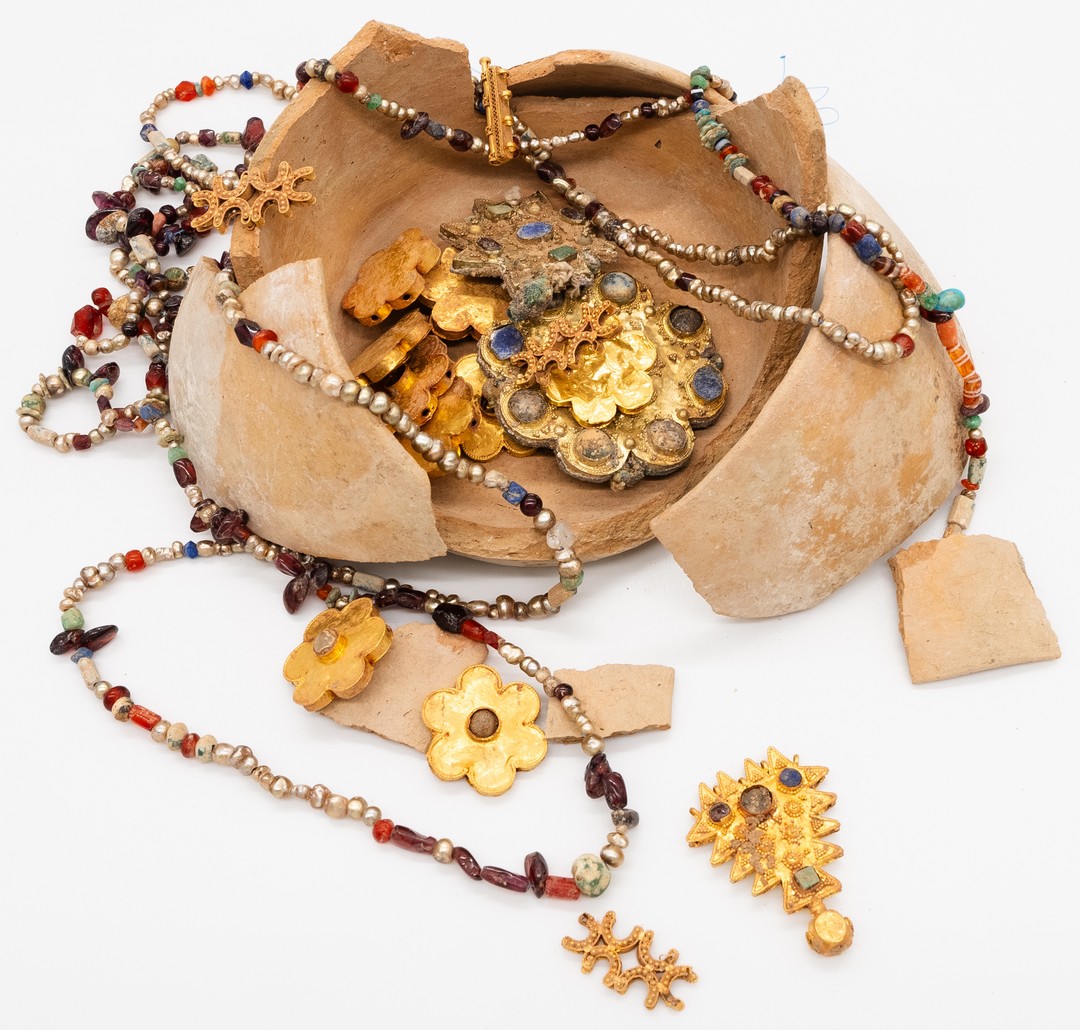
A hoard of more than 100 gold, silver, and gemstone ornaments was unearthed at Dariyah, sealed inside a ceramic vessel and dated to the 9th century A.D. The pieces—floral ornaments, gemstone‑inlaid pendants, bead bracelets, and a large multicolored disc—reflect high craftsmanship and significant wealth.
Their context shows that Dariyah was not just a stop on the Basran Hajj route but a thriving settlement tied to trade and pilgrimage. The find reveals active movement, exchange, and luxury production along Abbasid desert routes. It adds a vivid new chapter to early Islamic Arabian archaeology. (read more)
The Coggalbeg Hoard - Co. Roscommon

The hoard was discovered in 1945 by Hubert Lannon while cutting turf on his bog in Roscommon. Instead of reporting the find, Lannon brought the items to a local chemist’s shop in Strokestown in 1947. In 2009, the shop was robbed and the entire safe was stolen; the objects were later found by the Garda Síochána wrapped in paper in a rubbish skip.
Due to their light weight, police believe the thieves were primarily interested in cash and drugs and were unaware of the objects’ presence in the discarded loot. The hoard was recovered intact and transferred to the National Museum of Ireland. (read more)
Mooghaun North Hoard - Co. Clare

The Mooghaun North Hoard, discovered in 1854 near Newmarket-on-Fergus, County Clare, is one of the largest Bronze Age gold finds in Northern or Western Europe. Workers building the West Clare Railway uncovered a stone chamber containing over 150 gold objects.
Sadly, most of the treasure was melted down for bullion, with only 29 pieces surviving. These include 23 crescent-shaped bracelets and six neck collars, now housed in the National Museum of Ireland and the British Museum. The hoard originally weighed over 5 kg and featured bracelets, collars, torcs, and other items. Some pieces were copied before their destruction, preserving their designs. (read more)
Three Bronze Age Torcs Found - England
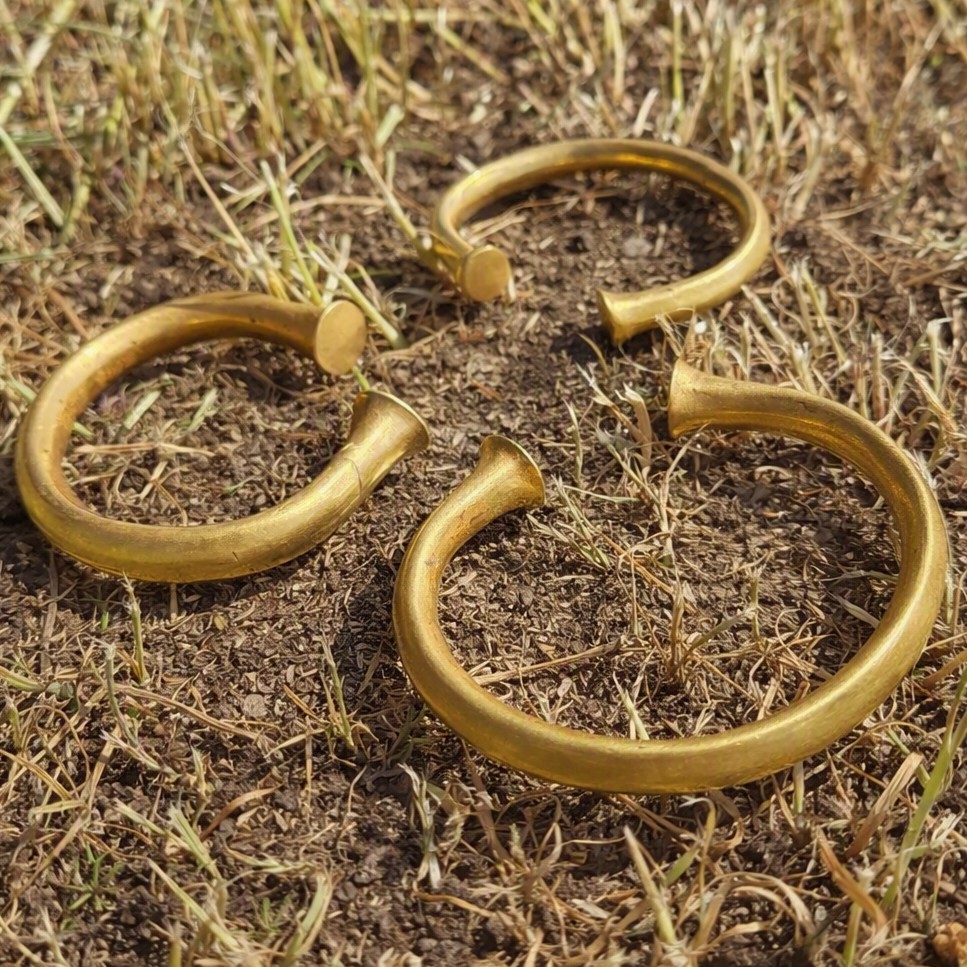
In May 2024, treasure hunters Alan Daniels and Andy Crammond from Kilwinning, Ayrshire discovered three Bronze Age gold bracelets during a metal detecting rally in Blackford, near Carlisle. The torcs, dated to around 1100 BC, are made of 22‑carat gold and weigh 518 grams in total.
They were found just a few inches beneath freshly ploughed soil and remained in pristine condition after 3,000 years underground. The remarkable find, valued at over £300,000, is now being assessed by the British Museum. (read more)
Bronze Age Gold Bracelet Unearthed in Gwynedd - Wales
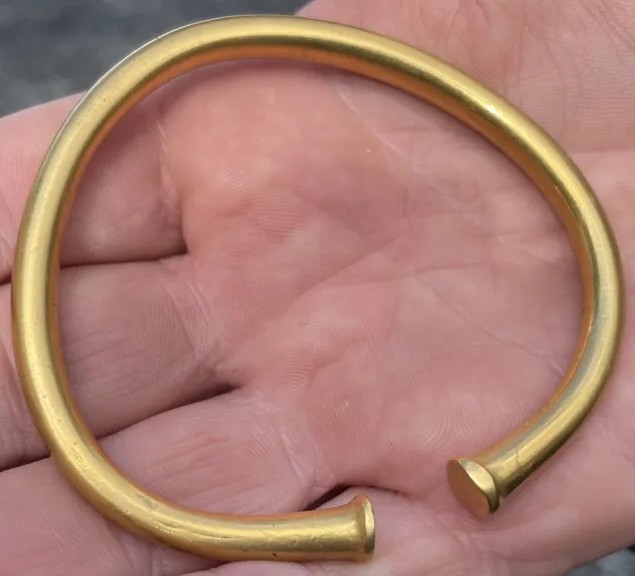
Metal detectorist Idris Thomas made an extraordinary discovery a late Bronze Age gold bracelet, around 3,000 years old, unearthed on farmland in Llanuwchllyn, Gwynedd. At first he thought it was just a piece of tin foil, but the flash of metal revealed an object composed of 92.8% pure gold. Experts from Museum Wales declared it treasure, and its value has been estimated at £15,000 to £20,000.
During the hearing in Caernarfon, the bracelet was described as “absolutely stunning” and believed to have belonged to a high‑status member of an ancient farming community. For Thomas, it is truly a once‑in‑a‑lifetime find that left him overjoyed and almost lost for words. (read more)
Bronze Age Gold Dress Fastener - Co. Roscommon

This Late Bronze Age gold dress fastener, or fibula, dates from around 900–700 BC and was discovered in 1819 at Castlekelly, County Roscommon. It was found five feet deep in gravel beneath layers of turf and was initially thought to be made of brass. The artifact consists of two large, cup-shaped discs joined by a hollow, drawer-handle-like staple, measuring 11 inches in length and weighing nearly 17 ounces.
The internal surfaces show signs of hammering, and the edges are decorated with deeply grooved fluting. Each disc is 5 inches in diameter, with ornate detailing around the neck of the handle. William R. Wilde catalogued and illustrated the piece, calling it the largest known example of a mammillary fibula. (read more)
Broighter Gold Hoard - Co. Londonderry

The Broighter Gold hoard was discovered in February 1896 near Lough Foyle, close to Limavady in County Londonderry. It was found by ploughmen Thomas Nicholl and James Morrow while working for Joseph L. Gibson. The treasure dates to the 1st century BC and was buried about 36 cm deep.
Among the artefacts is a miniature gold boat measuring 18.4 cm by 7.6 cm and weighing 85 g. The hoard also includes a gold torc, 19 cm in diameter, with buffer terminals and a mortice-and-tenon fastening. A gold bowl, 8.9 cm wide and 5.1 cm deep, weighs over 28 g. Finally, there are chain necklaces 39.6 cm long, crafted with triple chains. (read more)
A medieval figure of John the Baptist - England

A medieval figure of John the Baptist found in Essex. The saint is shown not in his usual attribute of a camel skin, but in the robes of a prophet. He gestures with his right hand to a salver, which he holds in his left. This was originally designed to carry a lamb, signifying the Lamb of God. A scroll issues from the Saint’s left hand and is inscribed with the words: ECCE +ANGUS+DEI (Behold, the Lamb of God).
The figure stands on a small plinth with a finished base. It is designed to be seen in the round and on its back there is a loop for attachment to an object. It would probably have been entirely enamelled, but no traces of enamel survive on the figure. The figure is gold and dates from the late fifteenth or early sixteenth century. Dimensions: height 33 mm, width 11 mm, depth 10 mm. (read more)
Anglo-Saxon Gold Raven and Ring - England

Metal detectorists in southwest England uncovered two stunning Anglo-Saxon gold-and-garnet artifacts: a ring and a raven's head. The raven's head features a garnet eye, intricate gold detailing, and may have once adorned a drinking horn. Ravens were symbolic in Norse mythology, often linked to Odin, though the exact meaning of this piece remains unclear.
The finds are undergoing cleaning and evaluation at the British Museum under the U.K.'s Treasure Act. Discoverers Paul Gould and Chris Phillips documented their emotional journey and shared it with the public. (read more)
Engraved silver thimble - Netherlands

In the sixteenth century, bridegrooms often gave their brides richly decorated household objects as wedding presents. The burgomaster of Flushing, Ingel Leunissen, gave this silver thimble to Sara van Reigersberg when they were married on 20 November 1594. The image on the top of the thimble, two clasped hands surmounted by a heart, refers to the bond of marriage.
Such symbolic imagery was common in Renaissance Europe, where everyday objects were often imbued with personal and emotional meaning. This thimble not only served a practical purpose but also acted as a lasting token of affection and marital commitment. (read more)
Gold Crucifix - Denmark
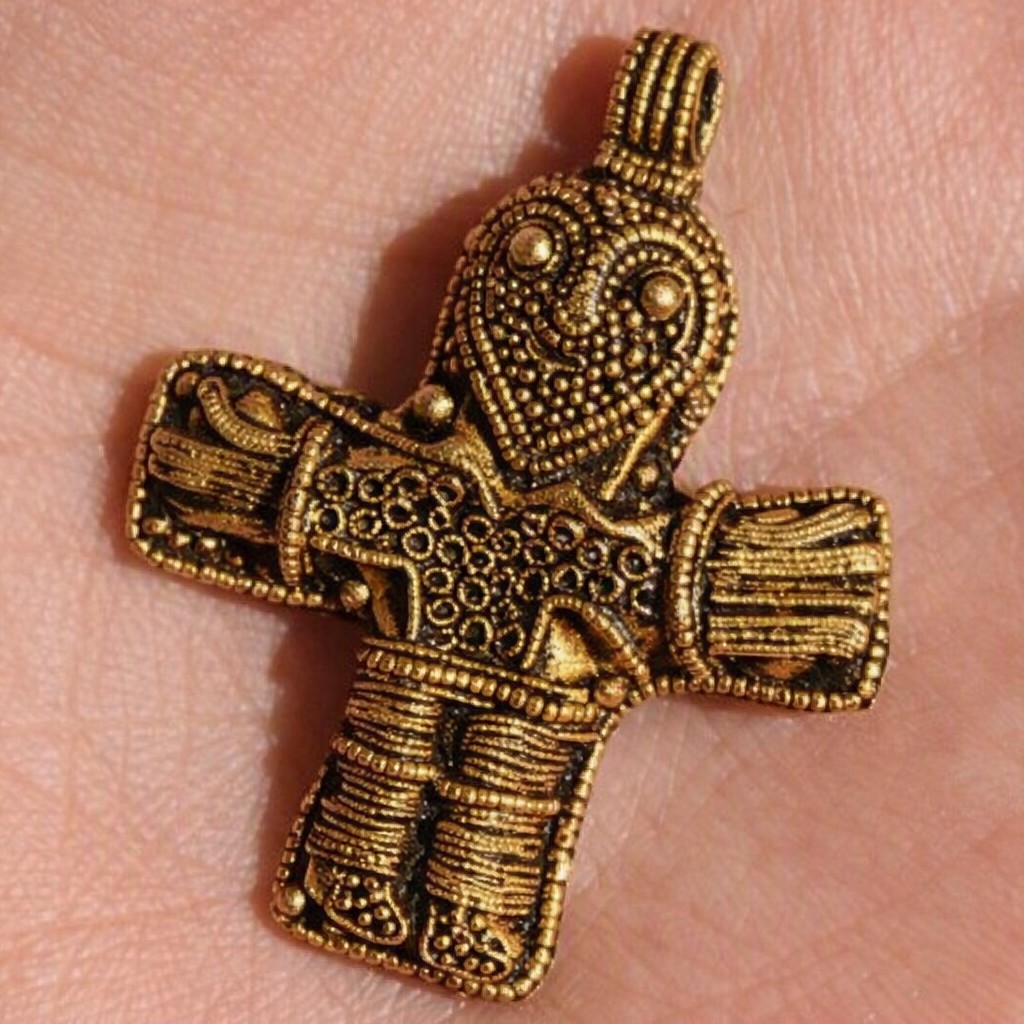
Dennis Fabricius Holm, a beginner metal detectorist, discovered a tiny gold crucifix in March 2016 in Aunslev on the island of Østfyn in Denmark. The piece is just 1.6 inches tall and crafted from fine gold threads and filigree. Archaeologists date it to the early 10th century, making it older than Denmark’s famous Jelling Stones.
A similar cross was found in a woman’s grave in Sweden in 1879, but Danish finds from this period were previously only fragmentary. Holm’s discovery may show that Christianity reached ordinary people in this region earlier than believed — or, as the Viking Museum Ladby jokes, it might simply have been a Viking’s decorative “bling‑bling.” (read more)
Saxon Cross Found in Leeds - England

A Saxon cross pendant, estimated to be around 1,200 years old was discovered in a field in Leeds, England. Made of solid silver and covered with gold leaf, the intricately designed pendant likely belonged to a person of high status, possibly a church official.
Despite damage, one arm broken and the central stone missing - it remains a remarkable example of early medieval craftsmanship. (read more)
Medieval gold brooch - England

The medieval gold brooch was discovered in Deopham, near Wymondham, Norfolk, by a metal detectorist in 2024. Dating back to the 13th or 14th century, the brooch is made of pure gold, weighs 1.5g, and features an enigmatic inscription believed to offer magical protection.
Dr Helen Geake, Norfolk’s finds liaison officer, highlighted it as one of the year’s most captivating finds, noting its “gorgeous buttery” hue and mysterious motto. The inscription may have been a personal code or a spiritual charm, possibly meant to be understood only by divine beings. Now officially declared treasure, the brooch will remain in Norfolk as part of a museum collection. (read more)
Marlborough Ring Brooch - Co. Dublin

This 13th-14th century ring brooch was discovered on Marlborough Street, Dublin, and is now part of the museum’s collection. Among the most delicate medieval artefacts at the National Museum of Ireland - Archaeology are ring brooches worn between the 12th and 15th centuries. These brooches, crafted from gold, silver, or base metals, they often carried inscriptions in Latin or French expressing love, faith, or protection. Many were found in Anglo-Norman regions of Ireland, though some emerged from Gaelic sites or by chance, like the 2017 Kerry beach discovery.
One brooch reads Par Amur Fin Sui Dune (“I am a Gift for Fine Love”), while another bears Amor Vincit Omnia (“Love Conquers All”). These brooches reflect medieval ideals of chivalry, status, and romantic devotion. (read more)
Anglo‑Saxon Gold Jewels Discovered in Lincolnshire - England

In 2023, two metal detectorists uncovered five Anglo‑Saxon gold and garnet jewels on a hillside near Donington on Bain in Lincolnshire, the largest assemblage of its kind ever found in the county. The pieces, dating to the 7th century, had been scattered by deep ploughing, suggesting they were recently disturbed. The group includes a finely crafted D‑shaped pendant, two circular gold pendants, a small beaded gold pendant, and a domed gold boss decorated with garnet cloisonné.
Several items show delicate tool-made damage, indicating workmanship rather than agricultural impact, and one piece may have originally been part of a brooch. Despite their association with high‑status female burials, no grave, human remains, or other Anglo‑Saxon artifacts were found at the site. (read more)
The Hockley Pendant - England

The Hockley Pendant is a small early 16th century gold reliquary discovered in 2009 by 4 year old James Hyatt while metal detecting with his father in Hockley, Essex. It is 3 cm in length, weighs 8.68 g, and has a gold content of up to 73%. Its front shows a female saint possibly the Virgin Mary or Saint Helena holding a cross, surrounded by delicate foliage and standing on a tiled floor. The reverse depicts the Five Holy Wounds of Christ, and a hidden compartment once held a relic, with only a few flax fibres remaining when opened by conservators.
The pendant’s sides bear the names of the Three Magi, believed at the time to offer protection against illness. Declared treasure, it was acquired by the British Museum for £70,000 and later featured on Britain’s Secret Treasures as one of the most significant public finds. (read more)
Golden Heart of the Tudors - England

A heart shaped gold pendant linked to Henry VIII and Katherine of Aragon, discovered in Warwickshire in 2019 by a metal detectorist is made of 24-carat gold and weighs approximately 317 grams. Adorned with Tudor roses, a pomegranate bush, and the initials "H" and "K," it likely dates to the early years of their marriage, around 1520. Despite its rich symbolism, experts believe it was hastily made, suggesting it may have been a prize for a courtly event like a joust.
Scientific analysis confirmed its Tudor-era origins, with black enamel indicating pre-1526 craftsmanship. The pendant is considered a nationally significant find and is now housed at the British Museum. (read more)
Roman padlock discovered - Germany

A 1,600 year old miniature Roman padlock was discovered in Westphalia, Germany, by metal detectorist Constantin Fried. Measuring just over a centimeter, the lock is unique in Europe and likely dates to the third or fourth century. CT scans revealed a complex internal mechanism, including a spring and bolt, showcasing Roman craftsmanship.
Researchers believe it may have secured a jewelry box and indicates trade between Rome and northern Germany. A replica was created to study its design, raising questions about the rarity of such miniatures. (read more)
The Bourgaud pocket sundial - United States

The Bourgaud pocket sundial, crafted in Nantes, France between 1660 and 1675, is a richly decorated timekeeping device with adjustable features for different latitudes. It was reportedly discovered in 1860 by Dr. Elisha Cannon while plowing a field in Montezuma, Indiana a curious find given its European origins. The sundial includes a bird shaped gnomon, a lunar volvelle, and bilingual compass markings, suggesting it may have traveled through French colonial territories.
Its journey to Indiana remains a mystery, though its presence aligns with historical French activity in the region. Acquired by the Smithsonian in the 1960s, the sundial continues to intrigue historians and curators alike. (read more)
The Canterbury portable sundial - England

The Canterbury Portable Sundial, also known as St Dunstan’s watch, was discovered in 1938 during work at Canterbury Cathedral. Dating to the 10th century, it consists of a small silver tablet with a gold peg shaped like an animal’s head, used to cast a shadow for telling time. Its faces are inscribed with Latin month pairs and holes for positioning the peg according to the sun’s angle.
The inscription around the edge reads “Health to my maker, peace to my owner.” Likely owned by someone linked to the Cathedral, it helped follow the Benedictine Rule’s timekeeping practices. (read more)
Post-Medieval portable pocket sundial - England

Were popular in England during the late 17th to 18th centuries, especially among rural communities. These simple timepieces used sunlight passing through a pinhole to cast a beam onto engraved hour markers inside a circular ring. The gnomon, or sliding boss, was adjusted to the correct month using initials like 'I F M A M I' and 'I A S O N D' flanking the slot. Though only accurate to about 10 minutes, they were practical before mechanical clocks became common.
One notable example was recovered from the wreck of the Whydah pirate ship, dating to 1717. Another was found in Lincolnshire alongside late 17th century artifacts. Typically made of copper-alloy, they measured around 40mm in diameter and weighed just under 20 grams. (read more)
Rare Roman Ring Found in Lincolnshire - England

A rare eight-sided Roman ring was discovered in a former drainage ditch in Lincolnshire, England. Experts believe the chunky copper alloy ring was lost between 200 and 410 A.D. by its original owner. Wessex Archaeology described the find as unusual but not entirely without precedent in the UK.
The ring reflects ancient Roman fashion trends and offers insight into everyday life of the time. Archaeologists humorously credited the "careless ancestors" whose mishaps led to modern discoveries. (read more)
Gold Mourning Ring Found Near Salisbury - England

During the club’s annual outing to Salisbury in England, held over the last weekend of August 2025, a remarkable gold mourning ring was discovered. The ring is precisely dated to 10th July 1738, marking the death of Samuel Pitt, whose name is inscribed on the piece.
Although found several miles from where the Pitt family once lived, the ring still holds a modern-day connection to their lineage, making the find both historically and personally significant. (read more)
300 Year Old Lovers’ Ring Found in Lancashire - England

A 300 year old gold posy ring inscribed with “present my affection” was discovered near Whittington Hall in Lancashire, England. The ring, dating between 1650 and 1750, was likely exchanged between lovers as a romantic token.
It was reported to the Portable Antiquities Scheme and is now housed at the Lancaster City Museum. Whittington Hall, a historic estate built in the 1830s, inspired the search due to its rich heritage. The ring’s inscription reflects timeless expressions of love across centuries. (read more)
Lost Victorian Ring Found - Africa

A gold mourning ring commemorating Scottish geologist Hugh Miller was found on a beach in Gordon’s Bay, South Africa. The 18-carat ring, engraved with Miller’s birth and death dates, likely belonged to his daughter Harriet, who emigrated to Australia after his death in 1856.
It was discovered in June 2022 by metal detectorist Cornell Swart, who sensed its importance immediately. The ring has since been donated to Hugh Miller’s Birthplace Cottage & Museum in Cromarty, Scotland. How it ended up on an African beach remains a mystery. (read more)
A rare Medieval bishop's ring - England

A rare Medieval bishop's ring was found in 2019 by retired firefighter Mark Sell in a field in Shipdham, Norfolk. The gold ring features a hexagonal sapphire, two emeralds, and two garnets. Sell discovered it after a faint signal from his metal detector led him to dig about nine inches into the soil. He was stunned to find the jewelled ring intact and in pristine condition.
The ring was reported and examined by the county’s Finds Liaison Officer. Jewellery expert Laura Smith said its design dates it to the late 12th or early 13th century and links it to the bishopric. After being displayed at the British Museum, it was sold at auction for £19,000. (read more)
Roman Relics Found on Irish Shore - Co. Down

In 2015, retired civil servant Brian Murray discovered two ornate Roman gold rings and a silver buckle on Murlough beach in Co Down. The artefacts, dating to the 4th or 5th century AD, were officially declared treasure by a Belfast coroner’s court.
Their presence in Ireland where the Romans never fully invaded has sparked fresh debate about Roman contact with the island. Experts suggest the items may have come from a shipwreck, a burial at sea, or a ritual offering. The exact location of the find is disputed between the Crown estate and the National Trust. (read more)
The Tudor Love Ring - England

A 15th-century Tudor gold "love ring" was discovered by amateur metal detectorist Lee Rossiter near Green Hammerton, North Yorkshire, on 19 April 2015. The ring features a ruby and emerald set in a flower-shaped design, and is engraved in Medieval French with "ne mem - bon", followed by a heart symbol.
It was sold privately to an antique dealer for a five-figure sum, though the exact amount was not disclosed. Local museums were unfortunately unable to raise the funds needed to purchase the ring. (read more)
The Lady Brook Medieval diamond ring - England

A 69-year-old metal detectorist named David Board discovered a medieval diamond wedding ring near Thorncombe, Dorset, during a field search in 2019. Initially mistaken for scrap metal, the ring turned out to be in almost perfect condition, featuring a gold hoop of two entwined bands and an inverted diamond. Inside, it bears a French inscription: “Ieo vos tien foi tenes le moy” - meaning “I hold your faith, hold mine.”
Experts believe it was the wedding ring of Lady Joan Brook, given to her by Sir Thomas Brook in 1388. Their marriage brought significant wealth to the Brook family, as Joan was the widow of a wealthy Bristol merchant. The ring reflects medieval ideals of chivalry and courtly love. It was auctioned on 29 November 2022 and was sold for £38,000. (read more)
14th Century Sapphire Ring - Slovakia

A 700 year old gold ring discovered in Slovakia’s Pustý hrad Castle features a rare reddish-purple sapphire from Sri Lanka. Originally found by a treasure hunter in 2001, the ring was studied by archaeologists in 2023.
Made around 1300, it includes lion imagery symbolizing strength, royalty, and Christian themes. Experts believe it likely belonged to a bishop and served as a ring of office. Its exotic gemstone highlights the reach of medieval trade between Europe and Asia. (read more)
Sherwood Forest’s Lost Sapphire - England

A rare 15th-century sapphire ring, discovered in 2016 near historic Sherwood Forest where Robin Hood is said to have roamed, was sold for £30,000 at Christie's on 27 November 2019. Found at Kirton, the gold-mounted ring features engravings of Saint Elizabeth of Hungary and the Infant Christ.
Nottinghamshire archaeologist Emily Gillott suggests it belonged to someone of high status, perhaps a visiting bishop. The sapphire likely originated from Ceylon, Burma or Kashmir, having traveled via trade routes to European cities like Genoa or Venice. Such a gem was believed to ward off poverty, envy, and witchcraft while protecting chastity and comforting the heart. Under treasure laws, the finder and landowner split the proceeds. Sherwood Forest, once vast, now spans just 375 hectares. (read more)
Roman General’s Ring Unearthed in Somerset - England

A 48‑gram gold signet ring depicting the goddess Victory was discovered in 2017 by detectorists Kevin Minto and Phil Costello during a rally in Somerset, alongside hundreds of Roman coins. After a legal dispute with the rally organiser, a coroner confirmed Kevin as the rightful owner. The South West Heritage Trust has now purchased the ring alone for £75,000, which Kevin split with the landowner and his detecting partner.
Experts describe the so‑called Ilminster Ring as an unparalleled find in Britain, offering new insight into Roman Somerset during the unrest of AD 286–296. The treasure will tour local schools before going on display at the Museum of Somerset, and Kevin believes more artefacts remain to be found at the site. (read more)
9th century Viking gold ring - England

A rare ring was part of the Herefordshire Hoard discovered near Eye, close to Leominster in Herefordshire in 2015. This 9th century treasure included coins, jewellery, a crystal pendant and a gold bracelet buried by Vikings around AD 870–879. Metal detectorists George Powell and Layton Davies illegally removed the hoard and attempted to sell it instead of reporting it as required by law.
The gold ring is considered one of the most important early medieval finds ever made in Britain. Its theft led to major criminal convictions and a long‑running effort to recover the missing artefacts. (read more)
Hellenistic Gold Ring - Greece

The J. Paul Getty Museum has acquired a remarkable Hellenistic gold ring featuring a tiny garden scene preserved beneath a domed rock crystal bezel. Dating to around 150 B.C., the ring is celebrated for its exquisite granulation, filigree, and unusually well preserved enamel work. Its miniature bouquet of gold flowers and leaves showcases craftsmanship of extraordinary precision.
After passing through several private collections since its first recorded appearance in 1912, the ring resurfaced at Christie’s in London in 2025. It ultimately sold for £100,800. (read more)
Detectorist Finds Pair of 15th Century Rings - England
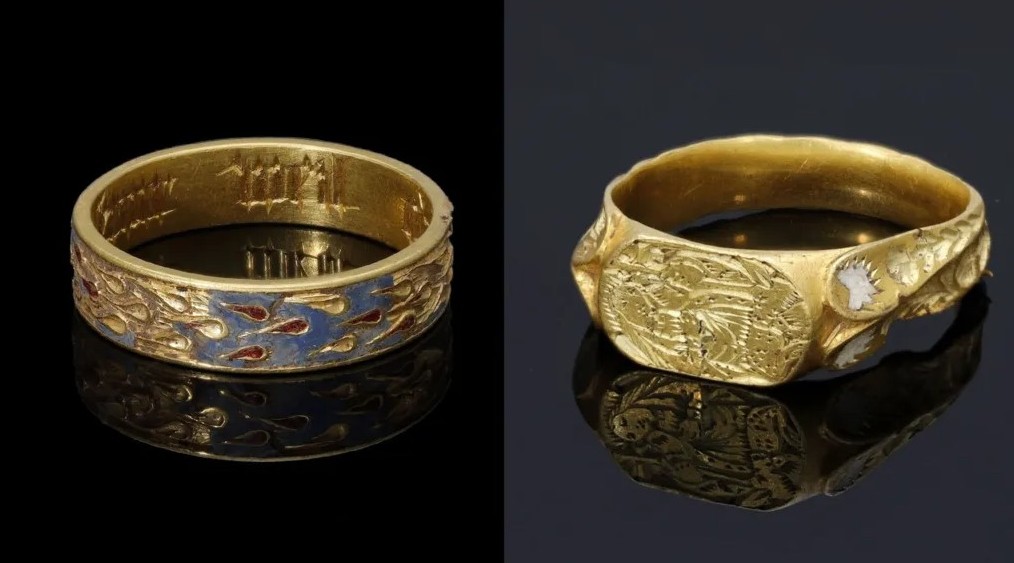
Two remarkable 15th century gold rings were discovered in North Yorkshire by detectorist Andrew Riley, with the first found in March 2024. Unearthed about eight inches deep, the so called "Blood of Christ" ring immediately stood out thanks to its inscription. Just four months later, on a hot summer evening, Riley uncovered the second piece an iconographic ring of St Margaret of Antioch after initially thinking the day would yield nothing.
Both rings were examined by a Finds Liaison Officer and formally declared treasure at Northallerton Coroner's Court. They are now set to be auctioned in London, with estimates exceeding £10,000 for the pair. (read more)
History
These stories and historical records reveal intriguing and mysterious aspects of Ireland’s past. You’ll learn about the 1931 discovery of an IRA arms dump near the Owendoher River in Killakee, and the legend of Princess Scotia, an Egyptian royal said to be buried near Tralee. There’s the tale of the 1672 Butcher’s Token fraud in Dublin, and the rare 1933 British penny worth £100,000, believed to lie beneath the foundation of a demolished church in London.
You’ll discover why barnyard animals appeared on Irish coins in 1928, and read about the golden crown unearthed in Glenasmole in 1788. The infamous 1907 theft of the Irish Crown Jewels remains unsolved to this day, while the Wicklow Gold Rush of 1795 drew crowds to the Goldmines River and even caught the attention of King George IV. Each account adds depth to Ireland’s cultural and numismatic heritage and there are many more fascinating stories well worth your attention, each offering a unique glimpse into Ireland’s rich and layered history.
Killakee Arms Dump - Co. Dublin

The Killakee house was demolished in 1941, and the subsequent history of the Massy Estate is dark and complex but well covered in the history books.
The estate was the subject of a raid in 1931, when an IRA arms dump was found by the Gardai beside the Owendoher River. The arms cache was booby-trapped, and held a tent, bedding, tinned food, and a supply of rifles, revolvers and explosives. (read more) (book)
Massy's Estate: Hidden Treasures - Co. Dublin

One of our readers decided to share some fascinating discoveries made while walking through Massy's Estate. Among the undergrowth, he found several military badges dating back to World War II, hinting at the area's hidden history. Even more astonishing were the old coins he uncovered, some from the late 18th century, worn but still legible.
His collection also included numerous silver sixpence and shilling coins, glinting with age and character. These findings offer a glimpse into the past and remind us that Massy's Estate holds more than just natural beauty, it’s a quiet keeper of forgotten stories. (Map)
Echoes of the old Farm - Co. Dublin

Fields that once hosted old farms can be treasure troves for detectorists and history enthusiasts alike. One of our readers recently shared photos of his fascinating finds, which I’m pleased to publish here. Among them are buttons, crosses, medallions, and silver and copper coins dating back to the early 19th century.
He also uncovered lead toys and everyday household items that offer a glimpse into rural life from generations past. These discoveries remind us how much history still lies hidden beneath our feet.
Irish Repeal Movement Button

These were worn by many in Ireland during the 19th century to show their support of Daniel O Connell and his fight for Irish independence. They could be purchased by people at O Connell’s Monster/Mass meetings which were fair-like and sometimes up to 1 million people attended. Many wore it confidently on their outer coats and others who struggled to survive working for Landlords and Authorities wore it in on the inside of their coats which could be flashed when needed to their fellow believers. For an item that was once so common they have become very rare and difficult to come by.
Irish Repeal Movement button. "God Save the Queen - Repeal of the Union." is a typical propaganda artifact of the Repeal Association from 1840–1847. The word “Agitate” was Daniel O’Connell’s rallying cry, symbolizing the constant stirring of public opinion and persistent pressure for reform. Combined with the inscription “Repeal of the Union,” it conveyed a clear political message: loyalty to the Queen, yet at the same time a firm demand for the restoration of Irish independence.
Father Mathew Total Abstinence brooch

Father Theobald Mathew was a Capuchin friar who in 1838 in Cork began an extraordinary social movement known as the Father Mathew Total Abstinence Association. Its aim was to encourage people to practice complete abstinence from alcohol, which at that time was of great importance since excessive drinking was one of the main social problems in Ireland. Mathew introduced a solemn pledge, taken publicly, which bound people to live in sobriety. In a short time the movement gained enormous popularity and millions of Irish people decided to take this step. It is estimated that the number of those who took the pledge reached as many as three million, making this one of the largest mass movements of the nineteenth century. His activity had not only a religious dimension but also social and moral, since abstinence was seen as a path to better health, family life, and economic stability.
Soon the movement spread beyond Ireland, reaching England, Scotland, the United States, and Canada. In many cities local associations were founded, functioning like fraternities, organizing meetings, lectures, and joint initiatives. Father Mathew became an extremely popular figure, and his work was widely reported even in the foreign press. During his travels to the United States he even met President Zachary Taylor, which shows how significant his mission was. In Cleveland in 1851, within two weeks, several thousand people took the pledge of abstinence, an event without precedent. The movement also had an economic dimension, since reducing alcohol consumption improved the material situation of many families. In Newfoundland the association became one of the most important workers’ organizations, combining the idea of sobriety with social solidarity. Father Mathew earned the nickname “Apostle of Temperance” and was regarded as a national hero.
After his death in 1856 the movement weakened, but his legacy remained alive. In Cork and Dublin monuments were erected to commemorate his work, and schools and organizations bear his name. The idea of total abstinence inspired later temperance movements, especially in Catholic circles. Mathew’s influence on the culture and social life of nineteenth‑century Ireland was immense and lasting. His activity demonstrated that one man, guided by faith and determination, could change the customs of an entire nation. (read more)
Hiberno‑Norse Silver Penny (997)

The Hiberno‑Norse Penny of King Sitric Silkbeard, minted around 997 in Dublin, is the earliest true coinage produced in Ireland. Struck in high‑purity silver, it closely imitates the pennies of the English king Æthelred II, blending Viking metalwork with Anglo‑Saxon monetary tradition. Its long‑cross reverse allowed the coin to be cut into halves or quarters, making it practical for everyday trade.
As dies were repeatedly copied over generations, the designs gradually became more crude, creating a wide range of distinctive Dublin variants. Today, these silver pennies are prized for their rarity and for the vivid glimpse they offer into the cultural crossroads of Viking‑Age Ireland. (read more)
Inchiquin Money Shilling (1642)

This Inchiquin Money Shilling of 1642 is a striking example of the emergency coinage issued during the early years of the Irish Confederate Wars. Produced in Dublin under the authority of Murrough O’Brien, Lord Inchiquin, it reflects the chaotic political and military conditions of the time. The piece weighs 5.52 grams and measures 30 mm, giving it a substantial presence compared to many contemporary emergency issues.
Its most distinctive feature is the stamped inscription 3 dwt: 21 gr: enclosed within a pellet‑bordered circle on both sides. This weight mark served as a guarantee of the silver content at a time when trust in circulating currency was fragile. Today, this shilling stands as an evocative reminder of Ireland’s turbulent 1640s and the improvisational minting practices that arose from conflict. (read more) (Pic)
The Ormonde Silver Coinage (1643–44)

The Ormonde money of 1643–44 was an emergency coinage issued in Kilkenny by James Butler, Duke of Ormonde, to fund Royalist forces during the Irish Confederate Wars. These coins were produced by melting down donated silver plate, resulting in crude, irregular pieces stamped with simple designs.
Their denominations followed English standards, but the workmanship reflected the desperate wartime conditions under which they were made. Because they circulated only briefly and were later withdrawn or melted, surviving examples are scarce today. This short‑lived coinage stands as a tangible reminder of political fragmentation, financial crisis, and improvisation during one of Ireland’s most turbulent periods. (read more)
The Ormonde Gold Pistole (1646)

The Ormonde gold pistole of 1646 is one of the rarest Irish coins, with only a few surviving examples. It was created during the Confederate Wars, when James Butler, Duke of Ormonde, urgently needed funds to support Royalist forces.
Struck from donated or seized gold plate and jewellery, it became the only gold coin ever minted in Ireland’s history. Its design copied Spanish pistoles to ensure acceptance in trade despite being produced under siege conditions. Crude workmanship, irregular shapes, and extremely low output make it a prized relic of wartime necessity and Irish numismatic heritage. (read more)
Infamous Butcher’s Token (1672)

In 1672, Dublin was facing a shortage of small change. To solve this, the city allowed merchants to issue their own tokens. Mic Wilson, a butcher, was granted permission to mint halfpenny tokens bearing his name and the Butcher’s Arms on the obverse, and St. George slaying the dragon on the reverse.
But Wilson had a cunning plan. He secretly counterfeited his own tokens producing far more than he was authorized to. When people tried to redeem them, he claimed he wasn’t responsible for the fake ones.
Since he had cleverly made the counterfeits himself, no one could prove the fraud, and he avoided liability. It’s estimated that for every genuine token, ten or more counterfeits were in circulation. The city of Dublin may have lost nearly £1,000, a huge sum at the time.
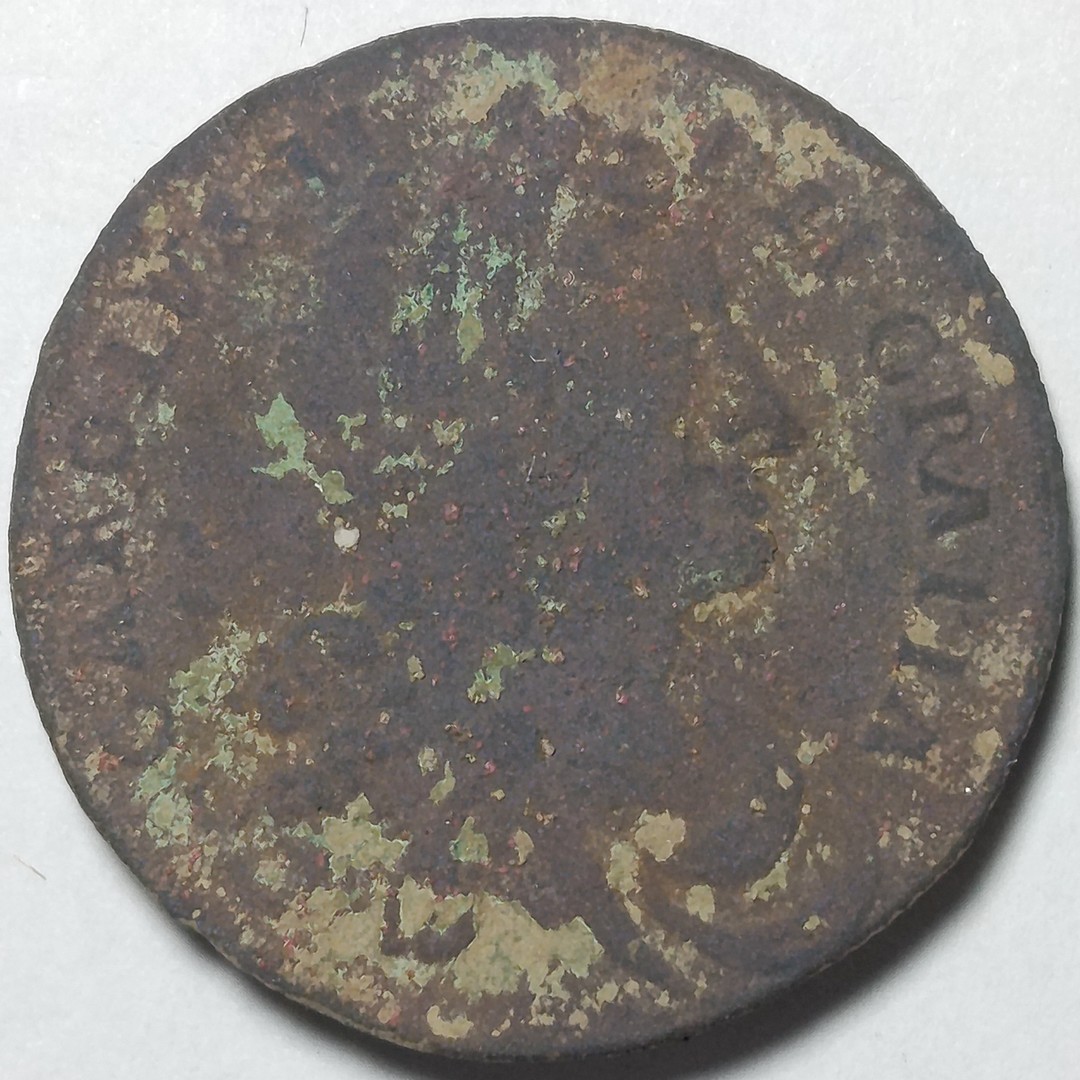
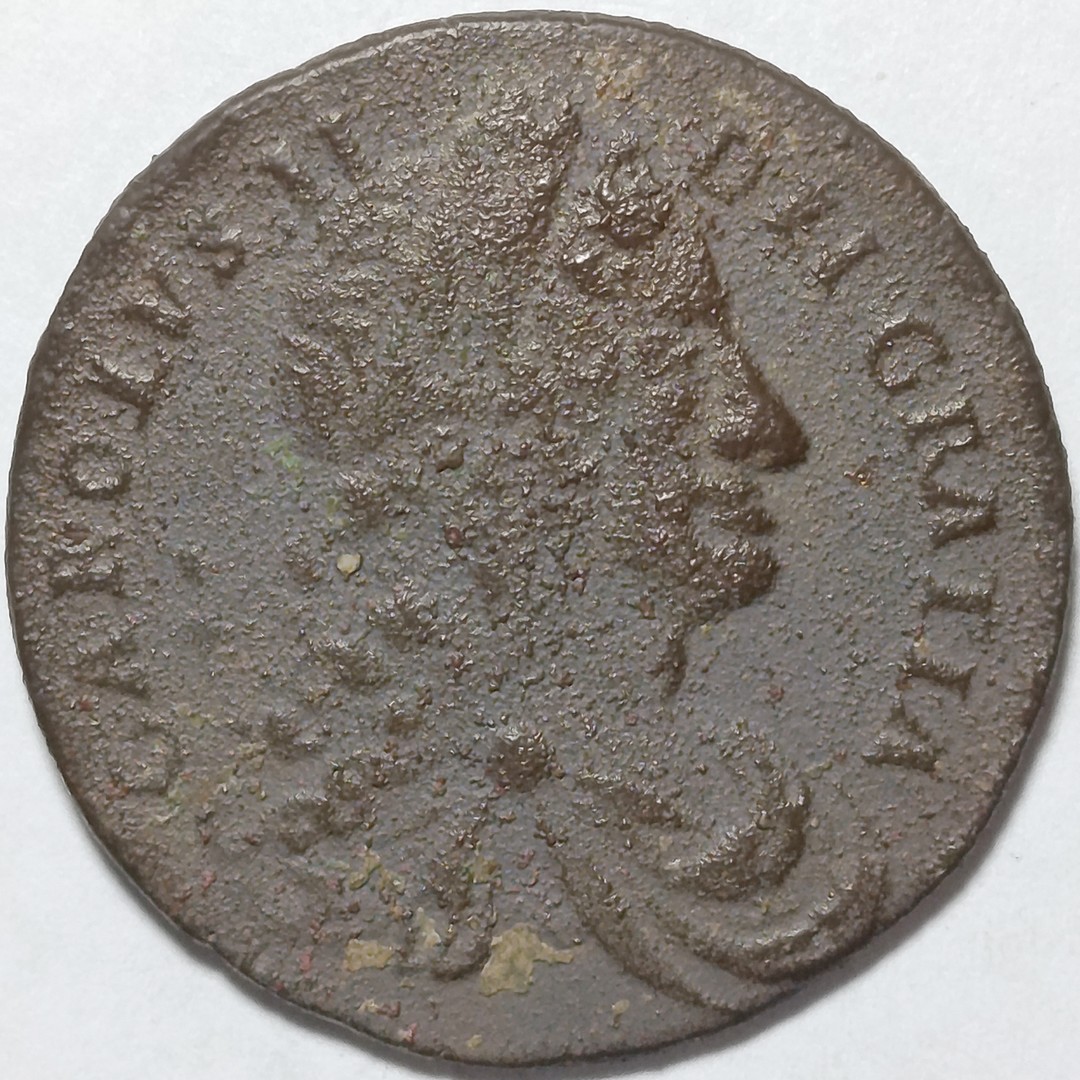
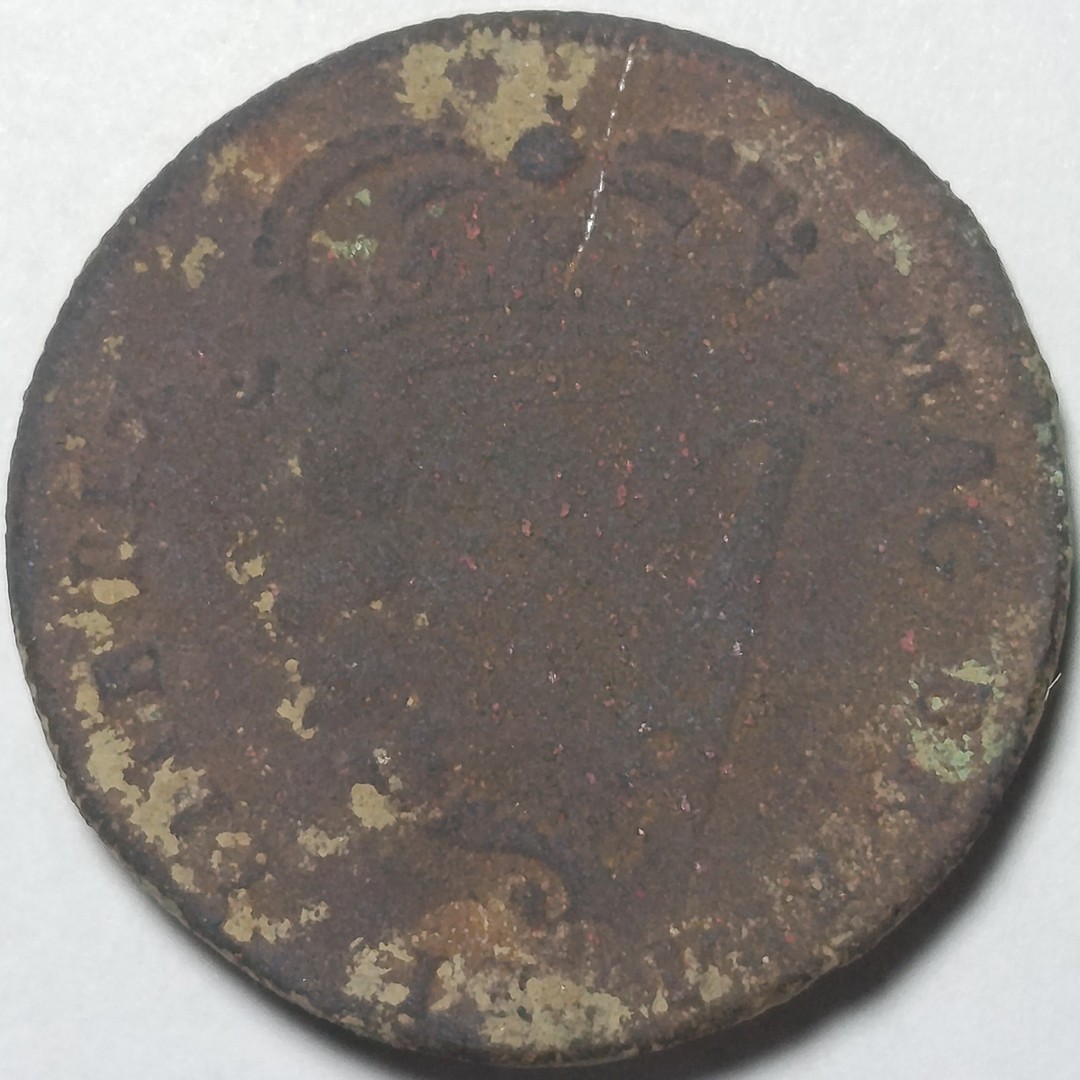
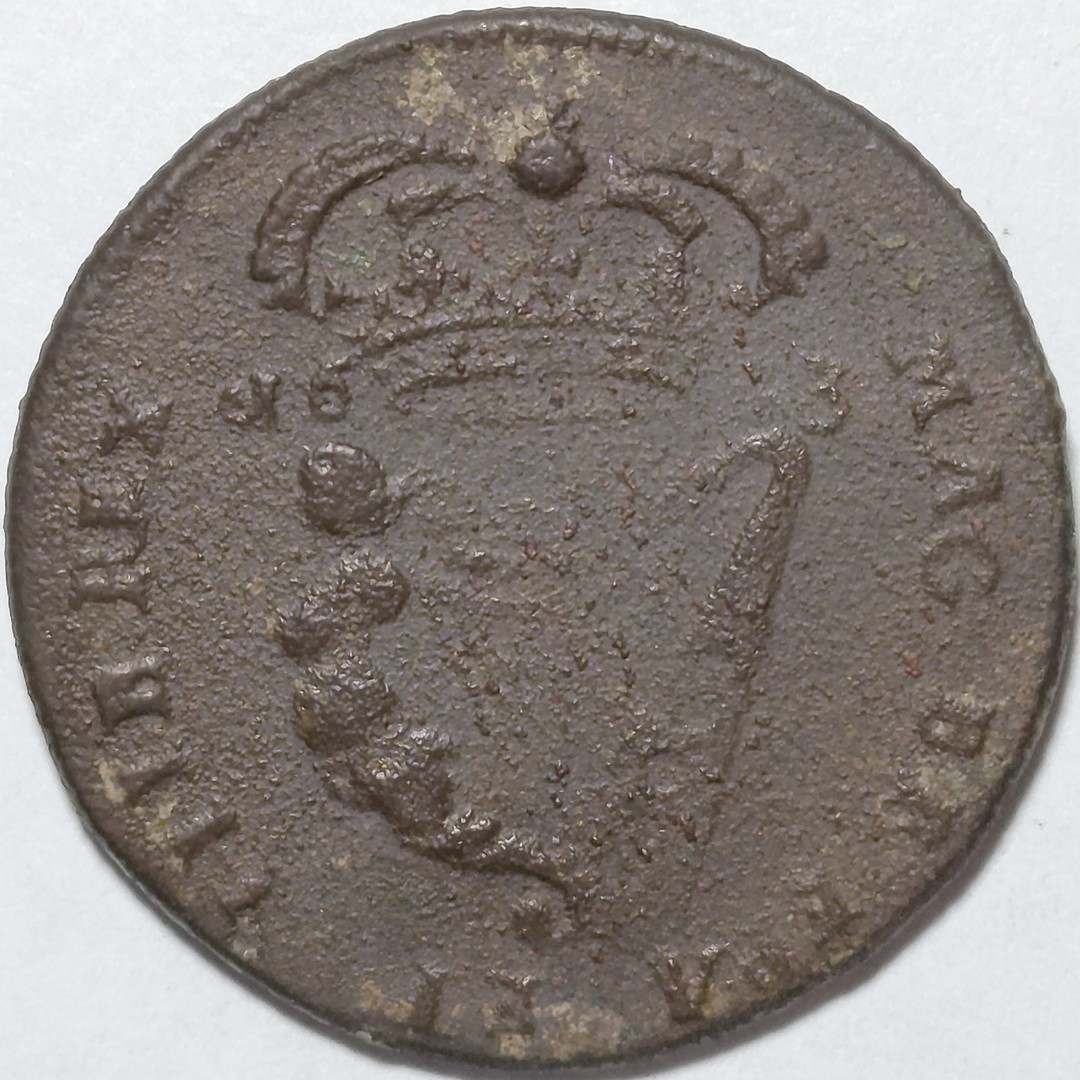
James II Gun Money (1689–1691)

Gun money was a base‑metal coinage issued by the forces of James II during the Williamite War in Ireland (1689–1691). The coins were made from copper, brass, and other available metals, and were intended to be redeemed for silver if James regained the throne. Each piece carried not only the year but also the month of issue, allowing for an orderly repayment schedule.
The name “gun money” comes from the belief that old cannons were melted down for the metal, though many other brass objects were also used. After James’s defeat, the coins circulated only at a much‑reduced value before being withdrawn in the early 18th century. (read more)
Final Coinage of James II: Limerick (1691)

After the Battle of the Boyne in July 1690, the Jacobite-controlled mint in Limerick continued striking coins in the name of James II, despite the increasingly desperate military situation. Remarkably, minting operations persisted until the city finally surrendered to the forces of William III on 3 October 1691. This makes the Limerick issues among the very last official coinages produced under James II anywhere in his former kingdoms.
In the months leading up to the final siege—and especially during the intense fighting of 1691—the Limerick mint produced halfpennies and farthings dated 1691. These emergency coins were struck on so‑called “gunmoney” blanks: pieces of base metal recycled from melted-down artillery, old weapons, and other scrap bronze. Although the original gunmoney series (1689–1690) was intended to be redeemable in silver after a Jacobite victory, the late Limerick issues were far more improvised. Their crude manufacture reflects the extreme shortages of metal and the collapsing administrative structure of the Jacobite regime.
The 1691 Limerick halfpennies and farthings are therefore historically significant. They represent the final phase of James II’s wartime coinage, produced under siege conditions by a mint still loyal to a king who had already lost effective control of Ireland. These coins stand today as tangible relics of the last Jacobite stronghold and the closing chapter of the Williamite War. (read more)
Irish 10 Pence Token (1805)

Some of the 1805 Irish bank tokens were made from low‑grade or poorly refined silver, which is why many surviving pieces show dark toning, black spots, or uneven colouring. These blemishes come from impurities in the metal reacting with air over time and are completely normal for this issue. The poor silver quality was a direct result of a severe silver shortage in Ireland during the early 19th century. The shortage was so extreme that the Bank of Ireland and private merchants imported large quantities of Spanish 8 reales to keep trade functioning. These Spanish “pieces of eight” were then overstruck or revalued because they were one of the few reliable sources of silver available.
Some interesting facts:
How Animals Ended Up on Irish Coins (1928)

Ireland’s first independent coinage, launched in 1928, featured Barnyard animals like a horse, pig, and salmon. English artist Percy Metcalfe won the closed design competition, impressing W.B. Yeats’s committee with his classical style.
The coins avoided portraits of living people, used Gaelic inscriptions, and displayed the Irish harp on one side. The animal theme was inspired by ancient Greek coins and meant to reflect Ireland’s agricultural heritage. Public reaction was mixed some praised the artistry, while critics like Maud Gonne saw it as too English. (read more)
£100K Coin Buried in London (1933)

The 1933 British penny is one of the rarest coins in UK history, valued at around £100,000. It was minted in extremely limited numbers for ceremonial purposes, including placement beneath buildings during foundation ceremonies.
One such coin is believed to lie beneath the cornerstone of the former Church of St. Cross in London. Although the church was demolished, the foundation stone and the coin may still be buried underground. Its rarity and historical significance have made it a prized item among collectors. (read more)
Discovery of a golden crown - Co. Dublin

On 28 June 1788, fifty years before O'Curry visited the area for the Ordnance Survey and noted with interest the location of the moat at Maureen's Brook, the following appeared in Faulk- ner's Dublin Journal: Last week some labourers belonging to Mr Dogherty of Glenasmole were cutting turf when one of them discovered a gold crown at about four feet deep. It is about seven inches in diameter and weighs eleven ounces. It is perhaps the crown of some provincial king, before the introduction of Christianity. There are several figures raised on it but no such thing as a cross.
The Theft of the Irish Crown Jewels - Co. Dublin

The Irish Crown Jewels included a diamond star, badge, and five ornate collars, totalling 394 jewels, largely from Queen Charlotte's collection. Valued today at several million euro, they were stolen from Dublin Castle’s Bedford Tower on 6 July 1907. Their disappearance occurred just before King Edward VII’s visit, when they were to be used in a ceremonial event. The regalia belonged to the Order of St Patrick, not the monarchy, and were overseen by Sir Arthur Vicars, Ulster King of Arms.
Numerous breaches in security were noted, including open doors and an intruder spotted by a cleaner. Suspicions fell on Francis Shackleton and Captain Richard Howard Gorges, though Shackleton was abroad during the theft. Some believe Vicars was scapegoated due to political sensitivities and social scandals. Alternative theories suggest involvement by republican or unionist groups, even connections to the royal family. Many offered help, but the jewels were never found. Vicars lost his position and died in disgrace, while the mystery remains unsolved to this day. (read more)
Ireland’s Greatest Art Robbery - Co. Wicklow

On the night of 1 May 1986, Martin Cahill’s gang broke into Russborough House and stole 18 paintings including Vermeer’s Lady Writing a Letter with her Maid - the only privately owned Vermeer at the time. The artworks were valued at over $45 million, and seven were found the next day in a ditch near the estate. The rest were hidden in a pre-prepared bunker, with rumors suggesting some may still lie buried in the Wicklow Mountains.
The Vermeer was recovered in 1993 by detective Charlie Hill, who posed as an art dealer in Antwerp. After its recovery, a tiny hole in the woman’s eye revealed Vermeer’s use of a 17th-century string-and-pin technique to construct perspective. (read more)
Ireland’s Most Infamous Heists: A Timeline of Crime and Intrigue

From art thefts to high-stakes bank robberies, Ireland has seen its fair share of dramatic heists over the decades. These events not only shocked the public but also revealed the evolving tactics of criminal masterminds across generations.
The saga begins in 1974, when IRA-linked activist Rose Dugdale led a daring raid on Russborough House, stealing 19 priceless paintings, including works by Rubens and Goya. Just over a decade later, in 1986, notorious Dublin gangster Martin Cahill - known as “The General” - struck the same estate, making off with 18 masterpieces, including a Vermeer, in one of Europe’s most audacious art thefts.
By 1995, the focus shifted to cash. A gang executed a military-style raid on the Brinks-Allied depot in Dublin, stealing over £3 million in just ten minutes. In 2001, Limerick saw a dramatic security van robbery, with €1.5 million taken at gunpoint.xxx
The stakes rose in 2004, when the Northern Bank Robbery in Belfast stunned the nation. Using tiger kidnapping tactics, criminals stole £26.5 million - still the largest heist on the island. Five years later, in 2009, a similar method was used in Dublin to steal €7.6 million from the Bank of Ireland.
In 2013, robbers disguised as Gardaí intercepted a cash-in-transit van in Meath, escaping with €500,000. The following year, Michael Flatley’s Cork estate was targeted, and a rare rhino horn worth €200,000 was stolen while the dancer was home.
The crime wave continued in 2015, when thieves used a stolen digger to rip an ATM from a wall in Cavan. By 2024, a new trend emerged: widespread theft of tax and insurance discs from parked cars in Dublin, used for fraudulent registrations.
Gold Rush - Co. Wicklow

In September 1795, a 682g gold nugget was discovered in the River Aughatinavought near Croghan Kinshela Mountain, Co. Wicklow. The find sparked a gold rush, drawing families with sieves and pans to the Goldmines River. The influx grew so large that the Kildare militia was sent to reclaim the area.
News reached London, and by 1820, King George IV visited the site. A local farmer gifted him a nugget he had hoped to sell, but the king simply pocketed it with thanks. (read more)
Massive Gold Nugget Found in Victoria - Australia

In March 2023, an amateur digger in Victoria, Australia discovered a rock containing 2.6 kg of gold using a basic metal detector. The find was valued at around £130,000 and described as a "once-in-a-lifetime" discovery by gold expert Darren Kamp.
Initially thought to be worth about £5,000, the nugget turned out to be the largest Kamp had seen in his 43-year career. The discovery took place in Victoria’s historic goldfields, known for their rich deposits since the 1800s. The finder chose to remain anonymous. (read more)
Fossils: My Discovery by the Dodder River - Co. Dublin

In Dublin, fossils can be found in several locations with exposed sedimentary rocks, such as Howth Head, Portrane, and the coastal areas near Malahide and Portmarnock. Dalkey Quarry and Killiney Beach also offer interesting geological formations where fossils may occasionally be spotted. Urban areas sometimes reveal fossils embedded in building stones or pavements made from fossil-rich limestone. While these places are more commonly known for fossil discoveries, unexpected finds can happen elsewhere. I personally found a fossils in the Dodder River, halfway between Bohernabreena North Car Park and the Bohernabreena Lower Reservoir - a surprising and exciting discovery!
After sharing a photo of the find, Professor of Palaeontology Maria McNamara emailed me back, confirming that "the photo shows a piece of a fossil crinoid in Carbonifeous limestone, ca. 330 million years old." (Map)
Kerry diamonds at Ballyheigue - Co. Kerry

In 1709, Samuel Molyneux described how to find “Kerry diamonds” near Kerry Head by descending a dangerous rocky precipice. These stones, likely amethysts, were once found in abundance and admired for their vivid colors and clarity. His father, William Molyneux, was Ireland’s first scientific weather observer, and Samuel himself recorded weather data before his Kerry tour.
Sir Richard Cox, visiting in 1687, praised the region’s gems, including topazes and aquamarines, as among the finest in Europe. By 1837, seekers still risked their lives, dangling from ropes to extract crystals from cliff crevices. The stones were embedded deep in the rugged rocks of Kerry Head. Today, however, these so-called Kerry diamonds have become rare. Their legacy lives on in folklore and the dramatic beauty of the headland. (read more) (shop)
The Boy Who Found the Impossible Stone - Co. Cork

Ben O’Driscoll’s muddy find in a Cork field turned out to be extraordinary: a genuine piece of cotterite, the first discovered in 150 years. Cotterite is one of the rarest quartz varieties on Earth, known for its unique silvery sheen and formed during a single, unrepeatable geological event in Rockforest. Only about three dozen specimens exist, all from the same narrow vein uncovered in the 1870s.
The mineral was first identified by Grace Elizabeth Cotter, whose curiosity led to its scientific recognition. In contrast to regular quartz’s clear, glassy crystal structure, cotterite’s unusual formation gives it its distinctive appearance. (read more) (Video)
The Sailor Who Changed Yap

David O’Keefe was an Irish sailor whose life changed forever when a violent Pacific storm destroyed his ship in 1871. He miraculously reached the shores of Yap, where the islanders rescued him and offered shelter despite knowing nothing about him. O’Keefe soon discovered that Yap followed an extraordinary system of value based on massive limestone disks known as rai.
He was fascinated to learn that these stones came from distant Palau and that obtaining them required dangerous sea voyages. A bold idea began to form in his mind: to use a modern ship to bring rai to Yap more safely and efficiently. The island chiefs agreed to cooperate, recognizing his courage and ingenuity. Together they sailed to Palau, where O’Keefe used steel tools and ropes to carve enormous blocks of limestone. His methods produced the largest stone money the island had ever seen.
Upon returning to Yap, he became an influential and respected figure. He traded copra, advised the chiefs, and gained a position no outsider had ever achieved. His success, however, stirred unease among colonial powers, especially the Germans. Missionaries also criticized his growing influence on local traditions. Some Yapese feared that the abundance of rai would weaken their ancient values. O’Keefe found himself caught between two worlds, trying to balance his ambitions with the customs of the island.
In 1901 he set out on another voyage, hoping for new opportunities. His ship vanished in a storm, and the wreck was later found near Guam. His body was never recovered, leaving his final fate shrouded in mystery. Today, the great stone disks he helped bring to Yap still stand as silent reminders of the man who tried to master the ocean and forever changed the island’s history. His story lives on as a legend told with respect and a touch of wonder. (read more) (Video) (Video)
Marconi’s radio station in Crookhaven - Co. Cork

Guglielmo Marconi arrived in Crookhaven in 1905 to attempt transatlantic wireless communication, erecting a mast at what is now Marconi House. Though the attempt failed, he established a telegraphic office and installed equipment at Fastnet Lighthouse, where Keeper Ryan famously sent the first message to his wife. Crookhaven, once a bustling port for ships crossing the Atlantic, became a key site for maritime communication, with operators relaying messages between ships and Europe.
By 1904, wireless technology had advanced rapidly, allowing communication with multiple ships simultaneously. Eventually, as Marconi succeeded in long-distance transmission, the need for a remote station faded and Crookhaven returned to its quiet coastal roots. (read more)
The story of Princess Scotia. Truth or myth? - Co. Kerry

Irish history records the story about Scota, the daughter of Pharaoh of Egypt who arrived in the southern part of Ireland between 4,000 and 3,500 years ago. She took on the trade route, sailing in search of the new world. She travelled to Spain from the Delta, by means of an Egyptian ship. She settled in the country of Kerry (south-western part of Ireland) and married Milesius and gave him eight sons.
Milesius, an invader from Spain, came to Ireland to conquest the ancient tribes and to take the kingdoms from Tuatha-De-Danaans. MacCuill, Mac Ceacht and Mac Greine fought in a long bloody battle about three miles from Tralee. Not only did the Danaan princes die in the battle of Tralee but also Scota the warrior Queen of the invaders was also killed. It seems that her sons Heremon and Heber were the only surviors of Milesius ruling family and that they divided the country between them. One took the north and the other the south. Then they inevitably quarrelled and Heber was slain.
Scota is buried on the sloped mountains in view of Tralee Bay at a place called Glenscoheen (Scota's Glenn). Irish archaeologists have not yet carried out any investigation on the site, which consists of woodland and natural rocks. The Ordnance Survey of Ireland has shown the actual location of the burial of Scota. (read more)
Grace O’Malley - the Pirate Queen of Ireland

Grace O’Malley, also known as Gráinne Mhaol, was a legendary Irish pirate queen who lived in the 16th century. Born into a noble seafaring family in County Mayo, she defied gender norms by commanding ships and leading men in battle. She became a powerful chieftain and maritime leader, controlling trade routes along Ireland’s west coast. Grace was known for her fierce independence, strategic mind, and fearless resistance against English rule. She famously met Queen Elizabeth I in 1593 to negotiate the release of her captured son, speaking as an equal to the English monarch.
Her fleet conducted raids, protected coastal communities, and maintained Irish autonomy during a time of political upheaval. Despite being labeled a pirate, she was also a diplomat, landowner, and protector of her clan. Grace’s legacy endures as a symbol of courage, resilience, and defiance against oppression. Her story blends myth and history, inspiring generations with tales of rebellion and leadership. Today, she is celebrated as one of Ireland’s most iconic and formidable women. (read more)
The Battle of Vinegar Hill - Co. Wexford

The Battle of Vinegar Hill took place on June 21, 1798, in Enniscorthy, County Wexford. The hill served as the main rebel camp and a symbol of resistance. Around 16,000 United Irishmen, armed mostly with pikes and scythes, faced 13,000 British troops under General Gerard Lake.
The battle began at dawn with heavy artillery bombardment. British forces attacked from three sides, aiming to encircle the rebels. Fighting was fierce, especially in the saddle of the hill. The rebels were defeated, with about 1,200 killed. (read more)
Sack of Baltimore - Co. Cork

In the early morning 20 June 1631, the coastal village of Baltimore in Ireland was raided by Barbary pirates. The attackers came from Algiers and were led by Murad Reis, a Dutchman who had converted to Islam. Guided by a local fisherman named John Hackett, the pirates targeted the village’s English settlers.
Over 100 people, including women and children, were captured and taken aboard ships bound for North Africa. The captives were sold into slavery, with many forced to work as galley slaves or domestic servants. Only a handful ever made it back to Ireland. The raid became known as the Sack of Baltimore and left a lasting scar on Irish history. (read more)
Lusitania Tragedy - Co. Cork

The Lusitania left New York on 1 May 1915, bound for Liverpool, but was torpedoed by a German U-boat off the coast of Cork on 7 May, sinking in just 18 minutes and killing 1,201 of the 1,962 people on board. Most survivors and recovered bodies were brought to Cobh, which played a central role in the aftermath.
On 10 May a funeral Mass was held for 150 victims in Cobh’s Old Church Cemetery, where many were laid to rest. Today, glass memorial headstones mark their graves, forming the heart of annual commemorations. Hendrick Verwey of Cobh Tourism describes the tragedy as part of the town’s identity, honored each year with prayers, music, and wreath-laying. (read more)
SS City of Cairo’s Lost Treasure

On 6 November 1942 the SS City of Cairo was sunk by German submarine U-68 while en route from Bombay to England, carrying 122 tons of silver rupees for the UK Treasury. The wreck lay buried 5150m beneath the South Atlantic, about 500 miles off St. Helena, deeper than the Titanic.
In late 2013 Deep Ocean Search recovered the silver valued at £34 million ($50 million), setting a world record for deepest salvage. The attack allowed most of the 302 passengers and crew to escape, with only six lives lost. The recovery effort began in 2011 and concluded in September 2013. Out of the 8 million coins that were recovered from the shipwreck, only 21,993 were saved (0.03%) - the rest were melted down for their silver value.
If you'd like to own a piece of this extraordinary history, you can buy one of the surviving coins from the Dublin Mint Office. These genuine silver rupees, struck over 100 years ago and salvaged from the deepest treasure recovery in history, are available while stocks last. (read more) (shop)
Spanish Armada in Ireland

The Spanish Armada in Ireland refers to the landfall made upon the coast of Ireland in September 1588 of a large portion of the 130-strong fleet sent by Philip II to invade England.
Following its defeat at the naval battle of Gravelines, the Armada had attempted to return home through the North Atlantic, when it was driven from its course by violent storms, toward the west coast of Ireland. The prospect of a Spanish landing alarmed the Dublin government of Queen Elizabeth I, which prescribed harsh measures for the Spanish invaders and any Irish who might assist them.
Up to 24 ships of the Armada were wrecked on a rocky coastline spanning 500 km, from Antrim in the north to Kerry in the south, and the threat to Crown authority was readily defeated. Many of the survivors of the multiple wrecks were put to death, and the remainder fled across the sea to Scotland. It is estimated that some 6,000 members of the fleet perished in Ireland or off its coasts. (read more)
Santa Maria de la Rosa: Armada Wrecks - Co. Kerry

The Santa Maria de la Rosa was a large Mediterranean-built merchant carrack, likely of Venetian or Genoese origin, refitted as a warship for the Spanish Armada of 1588. Commanded by Captain Martin de Villafranca, a Basque, she had already suffered damage near La Coruña before joining the fleet. During the Armada’s retreat around Ireland, she reached Blasket Sound off the southwest coast, seeking shelter behind Great Blasket Island. Tragically, she lost her anchor and struck an underwater reef, sinking instantly.
Only one survivor, a young boy named Giovanni, lived to tell the tale. His testimony provided rare insight into the ship’s crew and final moments. Though the wreck was discovered in 1968, speculation remains about artefacts and treasure possibly removed in secret during the late 1960s. Today, the story of Santa Maria de la Rosa is part of Ireland’s rich Armada legacy, echoing through the waters of Kerry. (read more)
La Trinidad Valencera: Armada Wreck Found - Co. Donegal

In 1971, divers from the City of Derry Sub Aqua Club discovered the wreck of La Trinidad Valencera, a Spanish Armada galleon that sank off Kinnagoe Bay, County Donegal, in 1588. The ship had been part of King Philip II’s fleet and was lost during the Armada’s retreat after its failed invasion of England. Over 400 crew members survived the wreck, but around 300 were later killed by forces loyal to the English crown.
The discovery revealed bronze cannons, anchors, and gun carriage wheels, confirming the vessel’s identity. Fifty years later, the find remains one of Ireland’s most significant underwater archaeological discoveries. (read more)
La Juliana: A Spanish Armada Shipwreck - Co. Sligo

La Juliana was an 860-ton Sicilian merchant vessel launched in 1570 near Barcelona and later requisitioned by King Philip II in 1586 for the Spanish Armada. Armed with 32 guns and carrying around 290 soldiers and 65 crew, she was part of the Levant squadron tasked with invading England.
In September 1588, La Juliana was wrecked off Streedagh Strand, County Sligo, along with two other Armada ships. For centuries, her identity remained uncertain until a 2015 storm revealed a bronze cannon bearing the mark of Genoese gunfounder Gioardi Dorino II and the image of Saint Matrona of Barcelona confirming the wreck as La Juliana beyond doubt. Artifacts from the wreck, including cannons and a gun carriage wheel, are now preserved by the National Museum of Ireland. (read more)
Legend of Baron D'Auburg - Co. Donegal

Just north of Burtonport in County Donegal lies Mullaghderg, a rugged stretch of coastline steeped in Armada lore. According to local tradition, one of the flagships of the Spanish Armada commanded by the enigmatic Baron D'Auburg was wrecked off this point in 1588, during the Armada’s disastrous retreat around Ireland.
The tale goes that the ship was carrying five tons of gold, intended to fund Spain’s military campaign against England. While no definitive archaeological evidence has confirmed the wreck or the treasure, the story has endured for centuries, fueling local legends and diving expeditions.
Informations
These resources offer a wide range of information related to numismatics, history, and exploration. You'll find details about coin shops and dealers in Dublin, such as Lir Coins and The Old Currency Exchange, where you can buy, sell, or get valuations for coins and banknotes. There are also rich online archives covering Irish currency, both coins and paper money as well as reference books and catalogues to help identify and assess your finds.
Practical tips are included, like how to safely remove verdigris from buttons, along with maps highlighting historic sites, movie filming locations, and gold panning spots in Irish rivers. Finally, an AI-generated comparison of metal detectors helps you choose the best equipment for your treasure hunting adventures.
Lir Coins - A Numismatic Gem in the Heart of Dublin

Lir Coins is a charming little shop tucked inside the George's Street Arcade in Dublin, specializing in collectible coins, banknotes, stamps, and postcards. The owner, Najee, is known for his friendly demeanor and deep knowledge of numismatics, often sharing fascinating stories about the items he sells.
Though small in size, the shop boasts a surprisingly diverse selection of Irish and international coins, with hidden gems often found behind the counter. It's easy to miss if you're not looking closely, so keep an eye out while browsing the arcade. Najee typically opens the shop from 10 a.m. to 3 p.m., and you can reach him at worldcoins@hotmail.com for inquiries or appointments. (read more)
Discover the Value of Your Euro Coins

Wondering how much your euro coins are worth - whether circulating or commemorative? On ucoin.net, you'll find a comprehensive catalog that lets you check the current market value, weight, and metal composition of each coin.
Commemorative €2 coins, issued by eurozone countries, often fetch higher prices due to their limited mintage and unique designs. It's the perfect resource for collectors who want to explore the details of their collection or discover rare pieces. With clear visuals and detailed data, the site makes coin collecting both informative and exciting. (read more)
Harness Rings Misidentified as Celtic Money

Many simple bronze rings sold as Celtic ring money are likely misidentified, as true Celtic currency was typically made of gold, tin, or potin and featured more complex designs. These rings often resemble coin hoards when found in clusters, but they are more plausibly remnants of ancient harnesses, where organic straps have decayed over time.
Some rings with knobs or lugs were used to separate leather straps and are better understood as functional harness mounts rather than monetary items. Spindle whorls and other post-medieval objects are also frequently mistaken for Celtic ring money. The most credible examples of actual ring money are gold or tin rings from Celtic sites, sometimes shaped like wheels and likely used for trade rather than standardized currency. (read more) (shop)
Colchester Finds Archive

The website Colchester Treasure Hunting Finds Index is a comprehensive archive of artefacts discovered by one of the world’s most successful metal detecting clubs. It features hundreds of categorized pages, each dedicated to specific types of finds from medieval brooches and Roman coins to military buttons and Saxon artefacts. Every entry includes photographs and often detailed descriptions, making it a valuable resource for historians, collectors, and enthusiasts.
The site reflects decades of fieldwork and collaboration, including ties with the Midwest Historical Research Society in the USA. Whether you're researching ancient jewellery or identifying obscure coinage, this index offers a rich visual and historical reference. (read more)
Lovci Historie – Czech Artefact Identification

The Lovci Historie section is a community space where detectorists upload their finds and request help with identification. The page features a constant stream of artefacts such as brooches, rings, bronze fragments, and other mysterious objects submitted by users from across the Czech Republic.
The creators emphasize that collaborative identification contributes to mapping archaeological discoveries across the country. The site additionally offers guidance on how to work with finds and explains how the identification process functions within the community. (read more)
Heritage Artefacts of County Cork

This publication opens with a sense of wonder, inviting readers into the deep history and prehistory of County Cork. It explores artefacts ranging from Neolithic stone axes to magnificent Medieval metalwork, each helping to illuminate the story of the people who lived there across the ages. The book showcases a rich selection of objects, from everyday items to extraordinary treasures.
As in previous volumes of the Heritage of County Cork series, it also highlights museums and heritage centres where these artefacts can be viewed firsthand. Now in its ninth edition, the series continues to be highly regarded and supported, celebrating the remarkable heritage found throughout County Cork. (PDF)
Medieval Coinage: A Practical Identification Guide for Archaeologists

Medieval coins are most often discovered by metal detectorists today, though they still appear on archaeological sites from time to time. This guide provides a clear and accessible introduction to identifying the main types of English medieval coins issued between 1066 and 1544. The first section explains the basic structure of medieval coins, including how to interpret their legends and recognise different denominations.
The second section offers a straightforward classification guide to the major coin types from the Norman Conquest to Henry VIII’s debasement of the currency. Together, these sections aim to equip archaeologists with a practical foundation for understanding and identifying medieval English coinage. (PDF)
Ireland’s Early Viking‑Age Silver Hoards
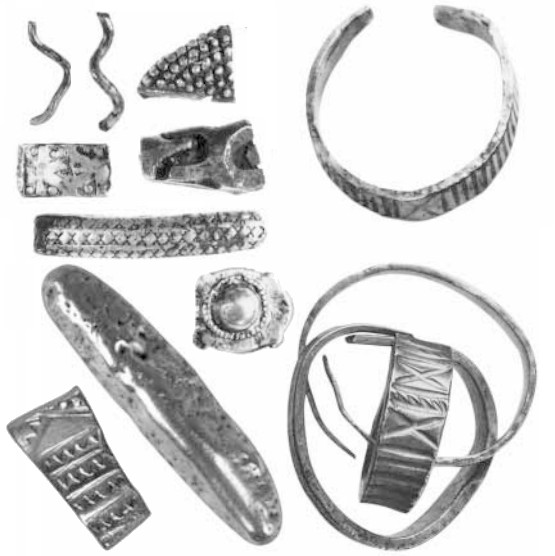
The book examines how Viking activity in Ireland developed under unique political and social conditions, resulting in a distinct urban, silver‑based economy. It highlights that “Ireland’s Viking‑age silver hoards represent a concentration of wealth which is not equalled elsewhere in the West,” emphasizing the exceptional scale of bullion found on the island. Most hoards date to the ninth and tenth centuries and consist primarily of ingots, ornaments, and hack‑silver linked to the Hiberno‑Viking silver‑working tradition.
The study classifies hoards into coinless, mixed, and coin-only groups, showing that non‑numismatic silver dominated before the rise of coinage and the Dublin mint around 997. Overall, the work demonstrates how these hoards illuminate economic networks, cultural exchange, and the formation of early urban centres in Viking‑Age Ireland. (PDF) (Pic)
Metal analyses of Viking-Age coins
The study analyses the silver content of Viking‑Age coins (c. 800–1150) using non‑destructive XRF to compare purity across diverse coinages. It discusses how “a silver content of c. 94% has been regarded as ‘pure’ silver” and how varying definitions of high‑quality silver affected trade. Pecking and bending were common Viking techniques for testing fineness, with unfamiliar coins receiving extra scrutiny.
The import of sub‑standard coins shows clear regional differences, especially between Gotland, Russia, and mainland Sweden. Overall, the analysis of 155 coins reveals how economic needs, silver availability, and regional trade preferences shaped the circulation of high‑ and low‑purity silver in the Viking world. (PDF)
Using Coins as Pendants in Viking-Age
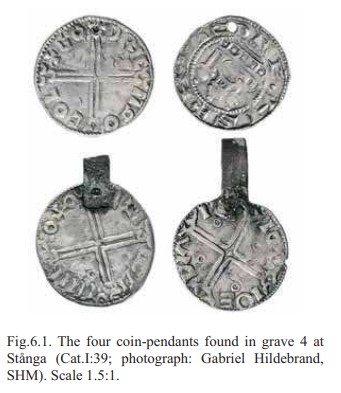
The page announces Florent Audy’s PhD defence at Stockholm University (25 May 2018). The abstract examines the Viking‑Age Scandinavian practice of turning coins into pendants. About three percent of coins show modifications such as holes or loops, shifting their role from economic to symbolic.
The dissertation aims to explain why coins became ornaments and what meaning they held for their owners. Using contextual and semiotic approaches, it studies how coins were selected, altered, oriented, and combined with other jewellery. The material includes 134 graves with coin‑pendants and 80 hoards. The study concludes that although the practice varied widely, coins had a special cultural significance in Viking‑Age Scandinavia, shaping the meaning of these pendants. (PDF)
The History Blog - Stories From the Past

The History Blog is a long‑running online journal dedicated to sharing remarkable archaeological discoveries, museum news, and historical curiosities from around the world. Its articles blend solid research with an engaging narrative style, making complex historical topics accessible and enjoyable to read.
The site is updated frequently, offering readers a steady stream of fresh stories ranging from ancient artefacts to modern restorations. Each post is richly detailed, often accompanied by images, context, and expert commentary that bring the past vividly to life. (read more)
3D views of archaeological artefacts

The Archaeological Dynamic Collections platform features interactive 3D models of selected Swedish artefacts, including flint tools and bronze ornaments. Users can rotate and zoom in on these models while accessing detailed metadata.
The BItFROST site is designed to host 3D representations of Norwegian artefacts, particularly from the Viking Age and medieval periods. Its interface allows filtering by museum, material, and time period. Both platforms contribute to the digital preservation and public accessibility of Europe’s archaeological heritage.
Coin identifications and valuations

Numista is a global platform dedicated to coin and banknote collectors, offering a massive collaborative catalogue covering all countries and historical periods. Users can identify, research, and manage their personal collections online, complete with photos and notes. The site also facilitates swaps between members, helping collectors exchange items and grow their collections efficiently.
A vibrant forum allows users to ask questions, share discoveries, and get help with identification or valuation. Numista regularly features updates on numismatic fairs, museums, and shops, making it a hub for both beginners and seasoned enthusiasts. (read more)
CoinsNB – Online Coin Auctions & Shop

CoinsNB is a professional numismatic platform based in Barcelona, specializing in auctions and direct sales of collectible coins. The site offers a wide range of items, from ancient Roman denarii to modern commemorative issues. Each coin is guaranteed authentic and supported by expert evaluation services, including grading and free preliminary assessments.
Users can participate in regular online auctions or purchase coins directly through the shop section. Overall, CoinsNB combines marketplace convenience with expert guidance, making it a trusted hub for both beginner and advanced collectors. (read more)
The Old Currency Exchange - Irish Coin & Note Dealer

The Old Currency Exchange is a specialist Irish dealer in coins and banknotes, offering services to collectors of all levels from beginners to experts. The site provides educational and entertaining content about Ireland’s monetary history, from Viking-era currencies to the modern Euro. They buy old Irish coinage, leftover foreign currency, and offer valuations for inherited or attic-found collections.
Visitors can explore a wide range of articles categorized by coin type, denomination, historical period, and mint. The site aims to build a complete narrative of Irish numismatics, with regular updates as new discoveries emerge. (read more)
Irish Coinage: A Comprehensive Online Archive

This website is a comprehensive resource on Irish coinage, covering currency used in Ireland from ancient times to the present day. First launched on 16 August 1994, it stands as one of the oldest coin-related sites on the internet. Originally created as a personal HTML learning project, it has since expanded to over 150 pages and includes more than 300 coin images.
The site is now a more extensive reference on Irish coins than many printed books, though it remains only about 30% complete. With an estimated 2,500 hours of work invested and ongoing updates, the creator continues to balance this passion project with other scholarly pursuits like a book on Edward IV. (read more)
Irish Papermoney: A Comprehensive Online Archive

IrishPaperMoney.com is Ireland’s oldest online archive dedicated to paper currency, active since 2000. It showcases hundreds of images of Irish banknotes from around 1800 to 2001, including all known dates of Lavery and Ploughman notes. The site offers over 150 pages of detailed content, covering historical and modern issues, including Northern Ireland’s polymer notes.
A lively forum provides collectors with updates on auctions, valuations, and new discoveries. With ongoing research and frequent updates, it remains one of the most comprehensive resources for Irish banknote enthusiasts. (read more)
Coins of England 2025: Pre-decimal Issues, 60th Edition

This historic reference work for British coins is still the only catalogue to feature every major coin type from Celtic to the Decimal coinage of King Charles III, arranged in chronological order and divided into metals under each reign, then into coinages, denominations and varieties. This Pre-Decimal volume lists all coinage up to decimalisation, with decimal coinage since 1968 is listed in a separate volume, available as an independent publication.
The catalogue includes up-to-date values for every coin, a beginner’s guide to coin collecting, numismatic terms explained and historical information about each British coin, from our earliest (Celtic) coins, Roman, Anglo-Saxon and Norman coins, the coins of the Plantagenet Kings, the Houses of Lancaster and York, the Tudors and Stuarts, to the more modern Milled coinage, minted for the first time in 1561 during the reign of Elizabeth I. (read more)
Metal Sewing-Thimbles Found in Britain

Metal Sewing-Thimbles Found in Britain by Brian Read is the first comprehensive reference dedicated to copper-alloy, silver, and mixed-metal sewing thimbles discovered across Britain. It covers domed, ring-type, and newly classified open-top thimbles, including rare and previously undocumented examples.
The book traces their use from circa 1270 through the 19th century, alongside detailed studies of palm-irons and finger guards. Each item is archaeologically illustrated to highlight construction details. This resource is invaluable for metal-detectorists, archaeologists, curators, and collectors seeking to identify and date sewing tools. (read more)
Welcome to Source

Welcome to Source, a rich digital archive dedicated to the local history and heritage of South Dublin County. It offers access to a wide range of materials including artefacts, audio recordings, books, and historical maps. Researchers and history enthusiasts can explore burial records, Irish Revolutionary Period documents, and South Dublin’s military heritage.
The archive also features unique collections such as the Quaker Collection and St. Patrick's Hospital records, alongside exhibitions and ephemera. Whether you're delving into old newspapers or browsing rare pamphlets, Source is a gateway to South Dublin’s vibrant past. (read more)
Soldiers Died in the Great War

"Soldiers Died in the Great War" is a series of volumes published in 1921 by His Majesty's Stationery Office, documenting British Army casualties from World War I. It includes detailed records of over 700,000 soldiers, both officers and other ranks, who lost their lives during the conflict.
Each entry typically lists the soldier’s name, birthplace, residence, enlistment location, rank, regiment, and the date and cause of death. These volumes were originally printed for official use but have since become valuable resources for historians and genealogists. Today, the data is accessible through various online archives and subscription-based genealogy platforms. (read more)
Removing Verdigris from Buttons - Step by Step

For tips on cleaning coins and buttons, check out these helpful guides and button cleaning techniques. (read more)
Mudlarking: Unearthing artefacts along the River Thames

In the 18th century, Georgians embraced extravagant fashion to showcase wealth and status, adorning themselves with ornate accessories like gem-encrusted buckles and glass-stone cufflinks. Mudlarking along the River Thames has uncovered beautifully preserved Georgian artefacts, offering vivid insights into their opulent lifestyle.
Cut glass paste stones, often backed with silver foil for added brilliance, mimicked precious gems and were worn by both aristocrats and the aspiring middle class. These glittering relics reflect not only the elegance of the era but also its social and political currents. (read more)
How to read Sterling Silver Hallmarks

The website is a detailed guide to decoding British sterling silver hallmarks. It explains how to identify the origin, purity, and age of silver items using official symbols and date letters. You’ll find information about assay offices, maker’s marks, and even commemorative stamps for royal events.
It’s especially useful for collectors, antique dealers, or anyone curious about the history behind silver pieces. The site is well-organized and packed with visual examples to help users recognize marks accurately. (read more)
UK Metal Detecting Clubs Directory

This page provides a comprehensive directory of metal detecting clubs across the United Kingdom. It lists clubs by region, offering details such as meeting times, locations, contact information, and links to individual club websites. The site is a valuable resource for enthusiasts looking to join a local group, attend rallies, or connect with fellow detectorists.
Many clubs welcome beginners and provide opportunities for organized digs, historical research, and community engagement. Overall, it serves as a central hub for anyone interested in the hobby of metal detecting in the UK. (read more)
Discover and visit movie locations in Ireland

If you've ever wondered "Where did they film that?" - discover the places where your favourite films were made, all over the world – the filming locations, background details, photos and basic travel info.
A clickable alphabetical list of films made, or partially made, in the Republic of Ireland listed below. Click on each title for the full location details, and, where appropriate, how you can visit and what you can expect to see. (read more)
Discover historic sites in South Dublin

Ever wondered what ancient secrets lie hidden beneath South Dublin’s gentle hills and misty valleys? This map reveals archaeological sites scattered across the region - from prehistoric tombs and Neolithic stone circles to Celtic forts and medieval monastic ruins. Each location is a doorway to the past, echoing with stories of early settlers, warriors, and saints. Let it guide you on a journey through time, where every stop deepens your connection to South Dublin’s rich and layered heritage. (Map)
Discover historic sites in Ireland
Ever wondered what ancient secrets lie hidden beneath Ireland's rolling hills and misty landscapes? This map reveals archaeological sites scattered across the country - from prehistoric tombs and Neolithic stone circles to Celtic forts and medieval monastic ruins. Each location is a doorway to the past, echoing with stories of early settlers, warriors, and saints. Let it guide you on a journey through time, where every stop deepens your connection to the island's rich heritage. (Map)
Gold panning in rivers

Grab your gold pan and head for the rivers - this map highlights locations in Ireland where gold has been discovered! With fresh air, flowing water, and a hint of adventure in every ripple, you might just uncover your very own golden treasure.
Just remember: any finds exceeding 20 flakes or weighing more than 2 grams must be reported to the authorities. Let the hunt begin! (Map)
GSI Open Topographic Data Viewer

GSI Open Topographic Data Viewer is an online platform developed and maintained by Geological Survey Ireland. It offers public access to high-resolution topographic data derived from LiDAR technology. The data is available in raster format, allowing users to explore detailed elevation models and terrain features.
The LiDAR data was collected using laser sensors mounted on aircraft or satellites, producing a dense cloud of elevation points. From this point cloud, digital elevation models (DEMs) are generated on a regular grid with cell sizes of 2 or 5 meters. The data is compatible with a variety of software tools, including open-source options like GDAL and QGIS. (Map)
Locations of sunken vessels

A shipwreck map is a captivating gateway into maritime history. It reveals the final resting places of thousands of vessels—merchant ships, warships, and legendary liners scattered across oceans and coastlines. Such maps allow you to explore famous wrecks near your own region, each with its own tale of tragedy, adventure, or mystery.
Beneath the waves lie stories frozen in time, waiting to be rediscovered by divers, historians, and curious minds. Studying these maps is like tracing the scars of the sea, silent witnesses to storms, battles, and human ambition. (Map)
Ogham Translator

For over 1500 years, the Ogham alphabet has been etched into Ireland’s history literally. Found on more than 300 ancient stone monuments across the country, Ogham was once used by our ancestors to honor loved ones and mark their lands. Today, it lives on as a powerful symbol of Irish identity and heritage.
This online translator offers a modern way to connect with that legacy, allowing you to explore the beauty and mystery of Ogham script and celebrate your roots in a meaningful way. (read more)
Comparison of metal detectors using AI

This table was created using artificial intelligence on 2 May 2025. It includes the metal detector model, the maximum detection depth for a specific coin, the coil size, the price, and the release date of the metal detector.
Metal detectors can detect objects at varying depths based on settings like sensitivity, ground balance, and frequency. These factors greatly affect how deep a target can be found.
ID for Gold: My Vanquish 540 Test Results

Gold can register across a wide range of target IDs depending on its size, purity, and shape. Very thin chains or large hollow earrings often appear extremely low, typically around ID 1–2. Small gold rings or delicate earrings usually come in slightly higher, around ID 5–6.
Most solid gold rings tend to fall within the broader range of ID 7–19. A gold coin, on the other hand, commonly gives a strong and stable signal around ID 15. (read more)
Locations
Looking for places you won’t find in any travel guide? Join me in exploring hidden corners of Ireland where nature and history intertwine from breathtaking waterfalls and winding rivers to dramatic rock formations once inhabited by people hundreds, even thousands of years ago.
Each photo is an invitation to step off the beaten path and discover the quiet beauty and timeless stories etched into the land. I include a short description and clear directions for each location - no fluff, just what you need to get there. If you're drawn to silence, space, and the echoes of ancient lives, these places are waiting for you.
The Cunard Portal Tomb - Co. Dublin

The Cunard Portal Tomb is a megalithic structure in the Dublin Mountains, overlooking the Dodder River near Tallaght. Dating back to the Neolithic period (3000-2000 BC).
It features two upright portal stones and a diamond-shaped capstone, which has shifted backward over time. Surrounded by rugged terrain and a small stream, it exudes an ancient, mysterious atmosphere. The photo was taken on 10 June 2025. (Map)
Knockeen Dolmen - Co. Waterford

Knockeen Dolmen is a remarkable Neolithic portal tomb located in Knockeen, County Waterford, Ireland, just a short drive from Tramore. Dating back to around 3500 BC, it features five large upright stones and two massive capstones forming a chamber with a distinctive keyhole-shaped entrance. The structure stands about 3.5 meters high and is considered one of the finest examples of its kind in Ireland.
It may have served spiritual or burial purposes, possibly aligned with lunar or solar events. The dolmen is part of the "Dolmen Drive" tourist trail and is accessible by crossing a field near the ruins of Kilbride Church. (read more)
Ogham stones - Co. Waterford

Ardmore in County Waterford is home to several remarkable Ogham stones, dating back to the 4th century AD. These ancient inscriptions are housed within Ardmore Cathedral and St. Declan’s Oratory, blending Ireland’s pagan and Christian heritage. One stone, known as Lugud’s Leacht, may commemorate St. Declan’s great-grandfather and features the name “Luguid”. Another bears the inscription “AMADU,” meaning “beloved,” and a third is preserved in the National Museum of Ireland.
The stones use the Ogham script - lines and notches carved along stone edges to record names and kinship. Ardmore’s collection offers a powerful glimpse into Ireland’s early language, identity, and spirituality. (read more)
Kilnasaggart Pillar Stone - Co. Armagh

A tall granite pillar marks an Early Christian cemetery along the Slige Midlúachra road from Drogheda to Antrim. Its long Irish inscription records dedication by Ternohc son of Ceran Bic under the patronage of Peter the Apostle, with Ternohc’s death noted around 714–716.
The pillar, dated to about 700, bears three crosses on the south-east face and ten on the north-west. Excavations in the 1960s revealed east–west graves and cross-carved slabs likely used as markers. The site gained its current enclosure in the early 20th century, with a bullaun stone nearby to the west. (read more)
Human Remains Found at Kiltipper Park - Co. Dublin

Human remains were uncovered during construction at Kiltipper Park, Tallaght, Co. Dublin prompting immediate cessation of works and notification of relevant authorities. Archer Heritage Planning Ltd conducted an Archaeological Impact Assessment in May 2025 to evaluate heritage constraints and guide future development.
Excavations revealed five articulated skeletons, multiple concentrations of disarticulated bones, and several likely and possible graves, all suggesting a pre-Christian burial site. Additional archaeological features included post-holes, pits, and a large ditch terminus. Further investigation and post-excavation analysis are recommended before construction resumes. (read more)
Lugmore: Urn full of gold - Co. Dublin

On the summit of the hill directly above the quarries in the townland of Lugmore, there is a well preserved cist grave, now lying open with the cover stones lying beside it. According to Malachi Horan this was known as Kenny’s stone from a man named Kenny who found an urn full of gold in it. Graves of this class belong to the early or middle Bronze Age and would date from about 1,500 B.C. to 2,000 B.C.
A few metres from the cist is a ring barrow cut across from its townland boundary and the part lying in Corbally townland destroyed. This would have belonged to about the same period. This fascinating account is documented in the book All Roads Lead to Tallaght, which offers a rich tapestry of local history and folklore from the area. (read more) (Heran's book PDF) (PL)
The Giant’s Causeway - Co. Antrim

It is made up of about 40,000 interlocking basalt columns, formed by volcanic activity around 50–60 million years ago during the Paleogene period. The site stretches for roughly 4 miles (6 km) along the Atlantic coast, between Causeway Head and Benbane Head.
Local legend says the columns were built by the giant Finn McCool, who wanted to create a path to Scotland. Today, the Causeway is one of Ireland’s most iconic landmarks, attracting over one million visitors annually for its mix of geology, myth, and breathtaking scenery. (read more)
Powerscourt Waterfall - Co. Wicklow

Powerscourt Waterfall, located just outside the village of Enniskerry in County Wicklow, is the highest waterfall in Ireland, cascading dramatically down 121 meters of rugged granite rock. It's part of the Powerscourt Estate and is a popular destination for nature lovers, families, and photographers alike
The area features a refreshment kiosk, picnic spots, a playground, and a scenic nature trail. The waterfall is especially impressive after heavy rain, when the volume and sound of the water become truly spectacular. Easily accessible by car, it’s about 30 minutes from Dublin and offers ample parking and facilities for visitors. (read more)
The Cunard Waterfall - Co. Dublin

The Cunard Waterfall is a small, picturesque cascade near the Cunard Portal Tomb in the Dublin Mountains. Flowing through rugged terrain, the waterfall adds to the mystical atmosphere of the area, with its gentle stream winding past ancient stones and lush greenery.
It's a peaceful spot, perfect for quiet reflection and enjoying the natural beauty of the Irish landscape. The photo was taken on 21 March 2026. (Pic) (Tomb) (Tomb2) (Map)
The Double-Ditched Ring Barrow, Rathcoole - Co. Dublin
Perched on the southern slope of Windmill Hill, this impressive double-ditched ring barrow measures around 80 metres across, with a flattened central mound of about 30 metres. The twin fosses are best preserved on the south-eastern side, where they reach depths of nearly 1.5 metres. While double-ramparted raths are not uncommon, a double-ditched barrow is a far rarer and more striking sight.
Despite the intrusion of a nearby pylon and some damage to its western arc, the monument remains a remarkably elegant earthwork. Another substantial and little-known monument on Dublin’s edge, just a stone’s throw from the Kildare border. (read more) (Map)
My Finds
Ever wondered what you might uncover with a metal detector while walking along beaches, parks, and fields? For me, it’s more than just a hobby it’s a journey through time. Every signal is a promise of history, from lost coins and bits of jewelry to everyday objects from decades or even centuries ago.
Below, you’ll see the results of my efforts: small treasures that once held meaning and now quietly tell their stories. Each find brings excitement, curiosity, and the thrill of discovery.
Two silver coins and....

Thanks to the permission I received from the farmer, I decided to go out with my metal detector. It was hard to find some shade, but the day brought many surprises.
I found: 6 pence 1929 Oak leaves (50% silver), 1 Shilling 1940 Bull (75% silver), 5 Shillings Winston Churchill Memorial 1965 (Copper-Nickel), Half penny 1942/1947/1950 (Bronze), One penny 1913 (Bronze).
Treasures from beaches and playgrounds
Jewelry and toys from the photos below can be found in the "Lost items" section.


Cleaning items before and after